So far in this blog, I have attempted to write about my early forays into the world of fountain pens in chronological order. I’ve written about my first pen, the missteps I took in trying to follow that up and how I then got myself ‘back on track’ by buying a reasonably cheap pen that was actually – subjective statement alert – great.
I’d like to now talk about some of the more successful budget buys I subsequently made, all of which cost under £20 / $25. While my post about my post Safari woes might have given you the impression that cheap is bad, nothing could be further from the truth, dear reader. Always a fan of bon marche, I think some of the misfits I initially purchased were a consequence of not doing enough research, buying pens that were too cheap and not having enough experience to know what I liked before pulling the PayPal trigger.
Like any concerned citizen of the fountain pen community, I suppose, I am enthusiastic about fountain pens and my great wish is to help would be compatriots avoid the same pitfalls and mistakes I made.
That isn’t to say that the pens I write about will be fantastic picks for all, of course. I am not arrogant enough to believe that! As with almost anything else, the collecting of fountain pens is highly personal. But, I hope that by writing about some of my picks, I’ll be able to highlight what I found good / bad about these pens – and that this will be of some use.
When internet shopping is your only option
One of the most often stated pieces of advice given to people seeking to purchase a new pen is to go to a store and try it. Give it a pen a test run before you buy it. Sometimes, that isn’t an option. I stated before that where I live is not imbued with fantastic locally based online stationery retailers. Admittedly, there are two great stationery shops to visit in person, but even then, they have their limitations. The range they carry in no way compares to that held by online retailers; I’d imagine this is a far from unique situation.
And part of me thinks this is a shame, not least because in this globalised world of low overhead online retail, we not only miss out on personal service and advice, a wider range of products in bricks and mortar stores, but also on regional variations: Canadian Parkers, English Esterbrooks, Australian Sheaffers etc. On the whole, for example, a Pilot Custom 74 is the same pen the world over. The subtle but discernable differences between English and American Parker Duofolds are no longer found. Then again, some of the pens I am about to discuss would not have come into being without licenced manufacturing before the age of internet shopping.
Conversely, we get access to products that we might never have before. 30 years ago, for example, would people outside of the US known about Noodler’s? Perhaps, even people outside of Massachusetts wouldn’t have known about them. And the same is true of a host of other brands, especially Chinese brands.
But the trade off for this increase in choice is that, for most people, it is impossible to “try before you buy” and test runs are conducted vicariously, by a random stranger on the internet.
I am not claiming to be a trailblazer, by the way.
The most populous country in the world
Whether from concerns over the actual quality of products, or those arising from sometimes justifiable anxieties over perceived working conditions, it seems that Chinese products are subject to greater scrutiny than others. Quality, is often questioned by use of the implicitly racist phrase, ‘Chinese ****’.
I find this a little strange due to the prevalence of goods that fill every household bearing the ubiquitous ‘Made in China’ stamp. Not that worries over working conditions can be so easily dismissed, as high profile cases involving well known brands such as Apple, Hasbro, Nike and Samsung demonstrate.
Personally, I do not understand some of the material condemnation of $2 Chinese pens, when the same people who make these criticisms will often defend pen manufacturers notorious for quality control issues, offering pens costing a minimum of 10 times as much! Indeed, many mid-to-luxury range fountain pens have parts that are made in China and assembled elsewhere.
Perhaps the problem isn’t with the provenance of the pen, but with its manufacturer’s QC thresholds. Of course, I fully understand the criticism of people who ask how a pen can be made, sold to a wholesaler (and possibly on to a further retailer), packaged and shipped across the world for a mere $2. Clearly, in such cases, something must be cheap; be it the material used, the labour employed, or quality of the finished product.
One thing that is often said about Chinese products, and not just fountain pens, is that a lot of items are cheaper clones of heavily influenced by established, more mainstream brands. While this is undeniably true, there is some qualification.
Firstly, in Chinese culture, imitation is said to be the sincerest form of flattery. Also, it hasn’t been until relatively recent times that the massive Chinese consumer base has been able to afford to purchase western brands. In such conditions, amplified by licenced manufacturing and lax copyright laws, derivation was bound to flourish. Secondly, and in the case of pens particularly, it is hard not to be derivative. There are, ultimately, only so many ways a tubular shaped object can be presented. The same, to a lesser extent, can be said about filling systems. Finally, none of these pens actually claim to be a genuine Parker, Sailor, TWSBI, Montblanc etc. I have seen many a Chinese pen on sale, yet I have never seen them claiming to be a brand that they are not. In the case of our first pen, I don’t have any problem with a pen manufacturer making a pen based on one no longer in production. Likewise, given that a Pilot Custom Heritage 823 retails for $270+ in the US, €350 in Europe (Pilot Pens are always more expensive in Europe) and no major UK pen retailer even carries it, I think it unlikely that the sub $20 Wing Sung 699 is going to eat in to Pilot’s target demographic. Although, as in the case of the Wing Sung 698, sometimes the waters can get murkier.
However, there are some fantastic Chinese fountain pens available and they are worthy of exploration. Here is a small list from the huge offerings to be had. It is in no way intended to be comprehensive or complete. In an attempt to keep this post brief , I’ll offer a short summary of each pen.
A Parker 51 improvement?
I’ll preface this by saying that I feel that the Parker 51 is one of the best and most iconic fountain pens ever made. I own a couple of Parker 51s and they are some of my favourite pens. They are real writers’ pens, made to be used, used and used again; real workhorses that 60-70 years after production still just work – and don’t need to be handled with kid gloves. Maybe one of the reasons it is so often imitated is because it is such a great pen. There have been quite a few Chinese Parker 51 clones: several offerings from Hero (most notably 616, 329, 100), Jinhao 911, Jinhao 51a, Wing Sung 618 and finally, the pen I will discuss next, the Wing Sung 601/601a.
First things first, and possibly a spoiler alert, this pen is not better than the Parker 51. But, it does have a lot going for it.
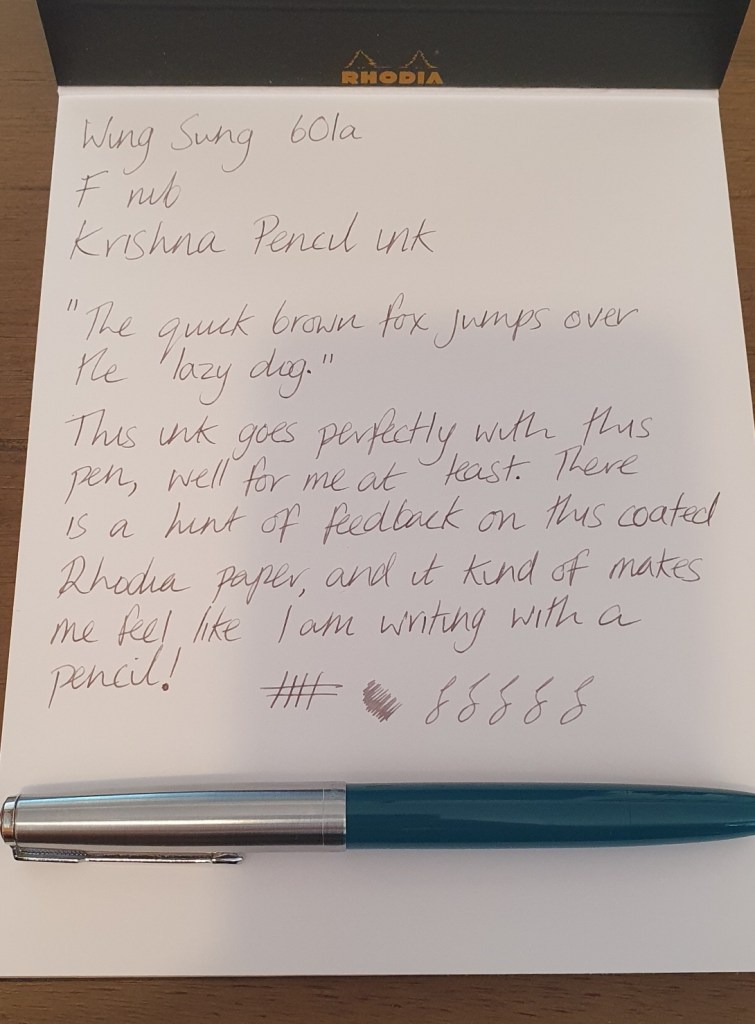
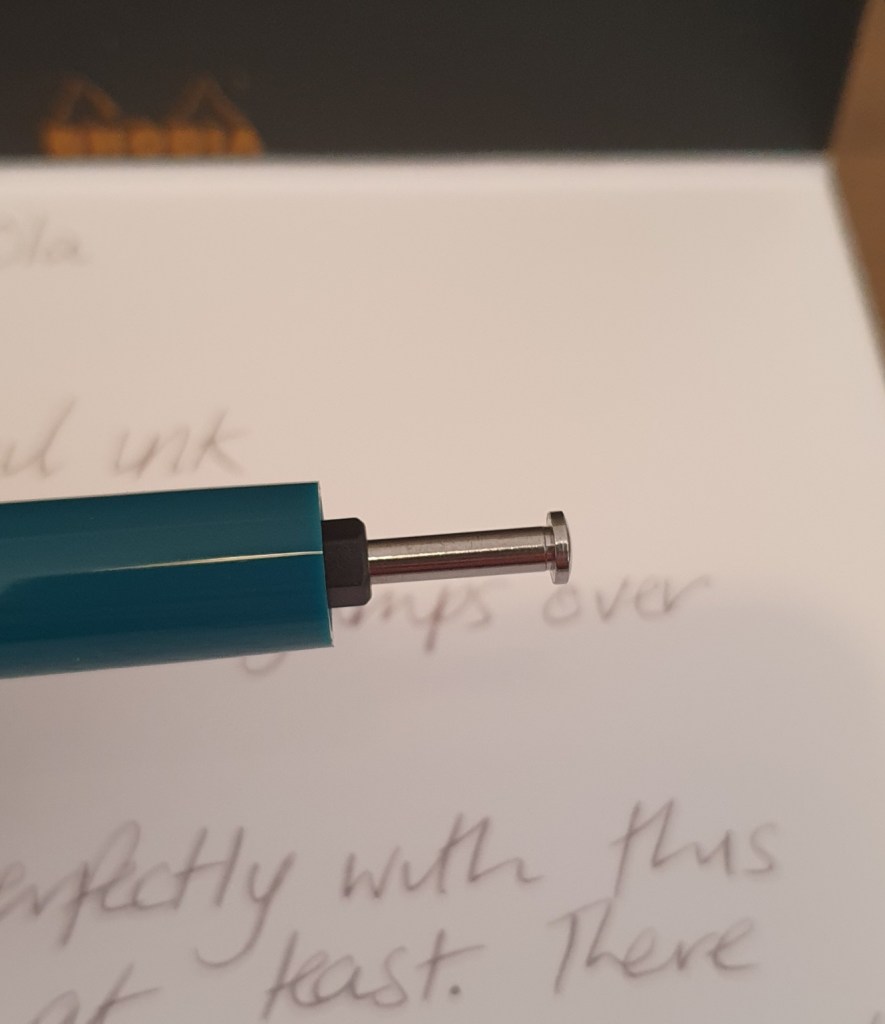
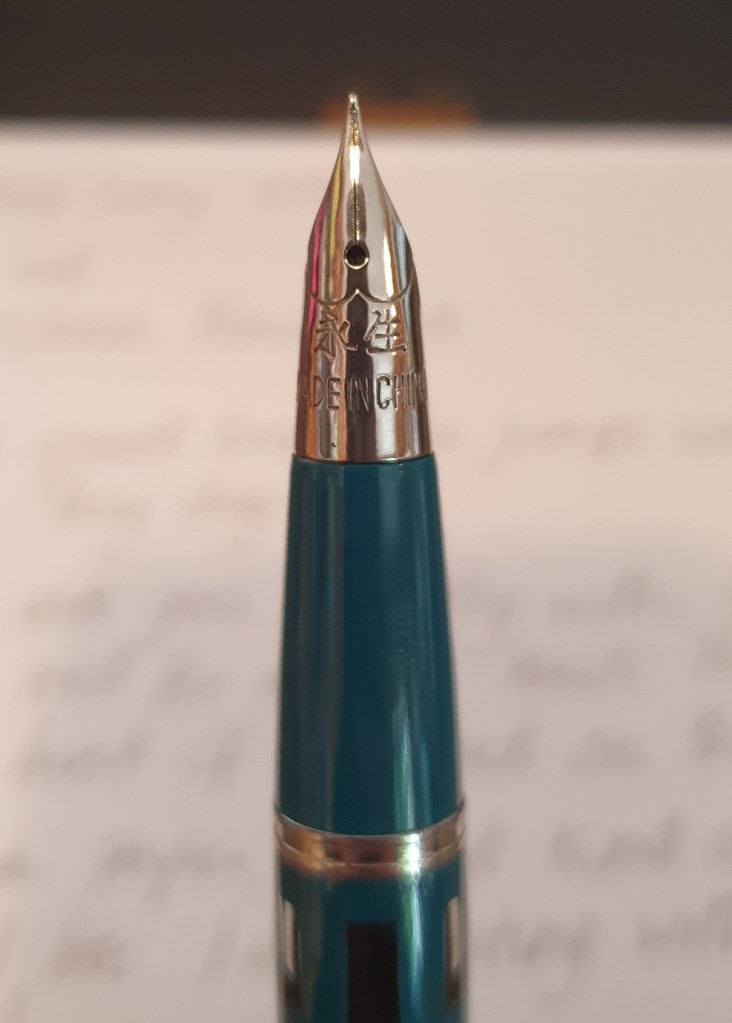
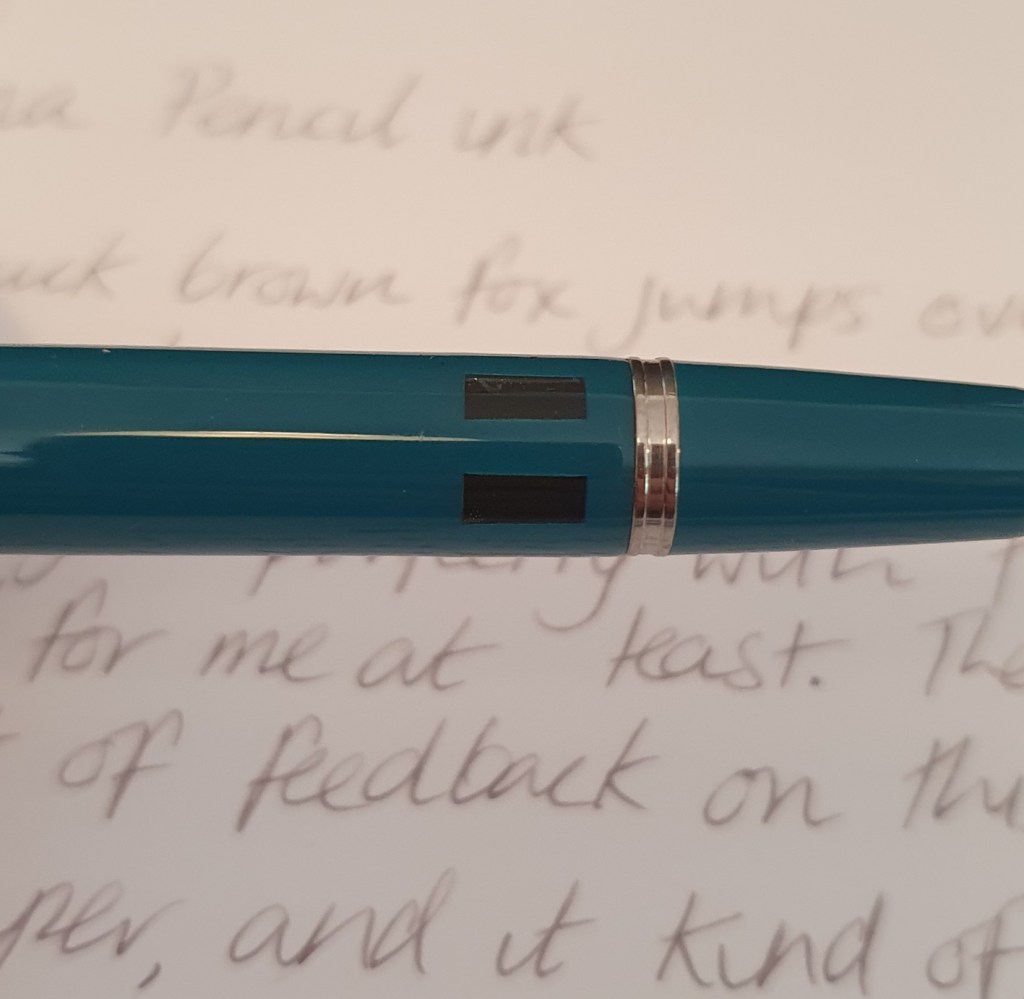
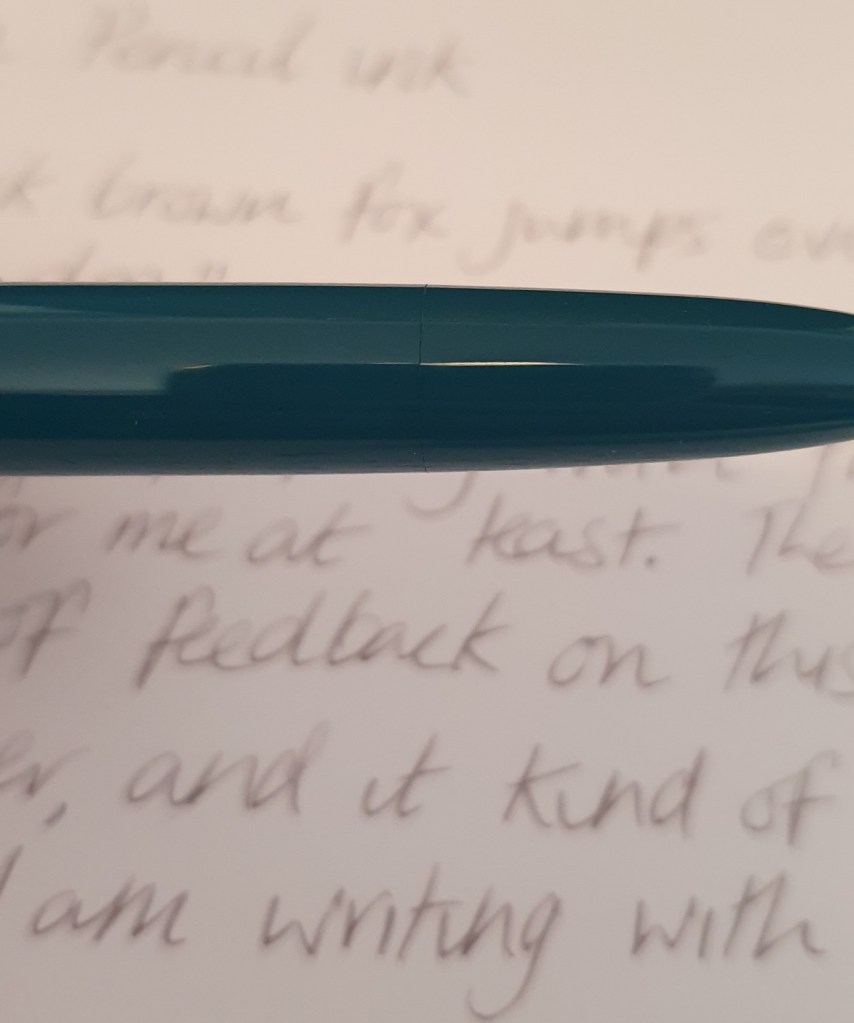
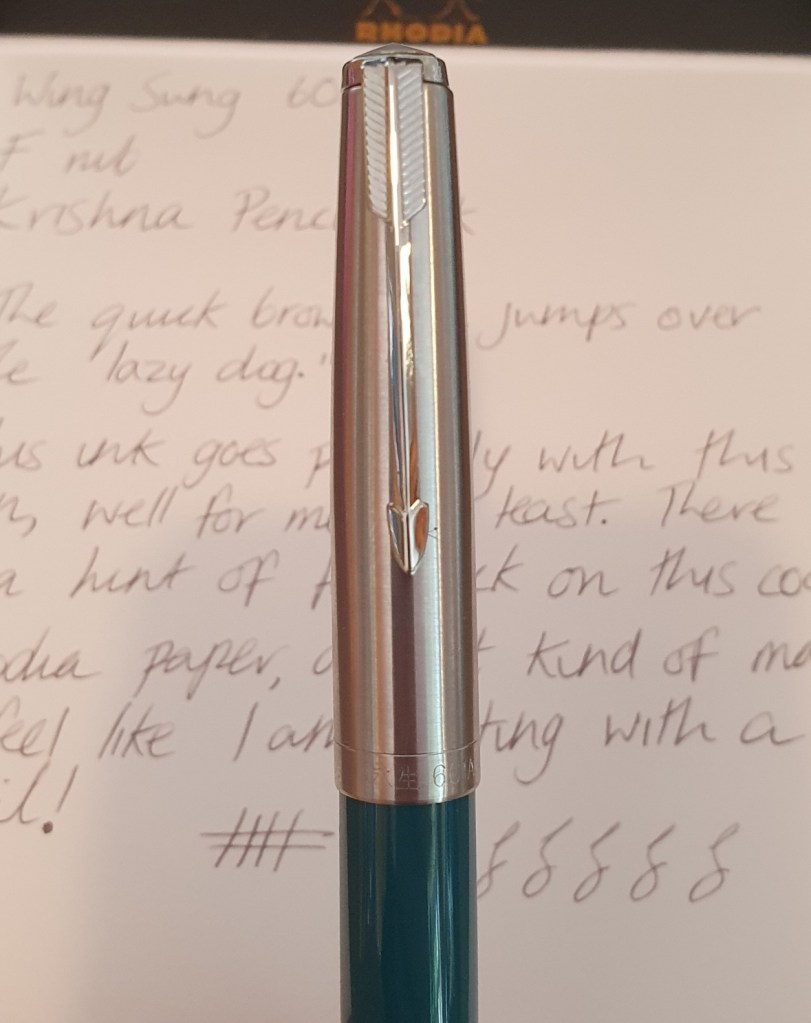
Purchase Price: $17 (eBay)
The Good:
- Probably the closest you can come to a Parker 51 without owning one (601 particularly, 601a has a different nib)
- Vacumatic type filling system that is actually an improvement over the original (IMHO)
- Easy to disassemble – supplied with tool to aid disassembly
- Ink window allows you to see ink level
- Lovely, smooth Sheaffer Triumph style nib (601a only)
- Massive ink capacity (2.0ml)
- Decent build quality
- Does not feel cheap – you could easily pay £50/$60 if a similar unit was made by a ‘mainstream’ manufacturer and still be happy
The Not So Good:
- Inconsistent quality control – there are many reports of poor quality nibs
- The nib is a nail (very hard, with no give or flex)
- On the 601a, the large ‘Made in China’ imprint could be considered a little gauche
- Engineering tolerances are not perfect – you can clearly see the blind cap seam, for example
- Only available in EF or F
Essentials:
Capped: 14cm, Posted: 15.5cm, Weight: 19.5g
The big brass cigar
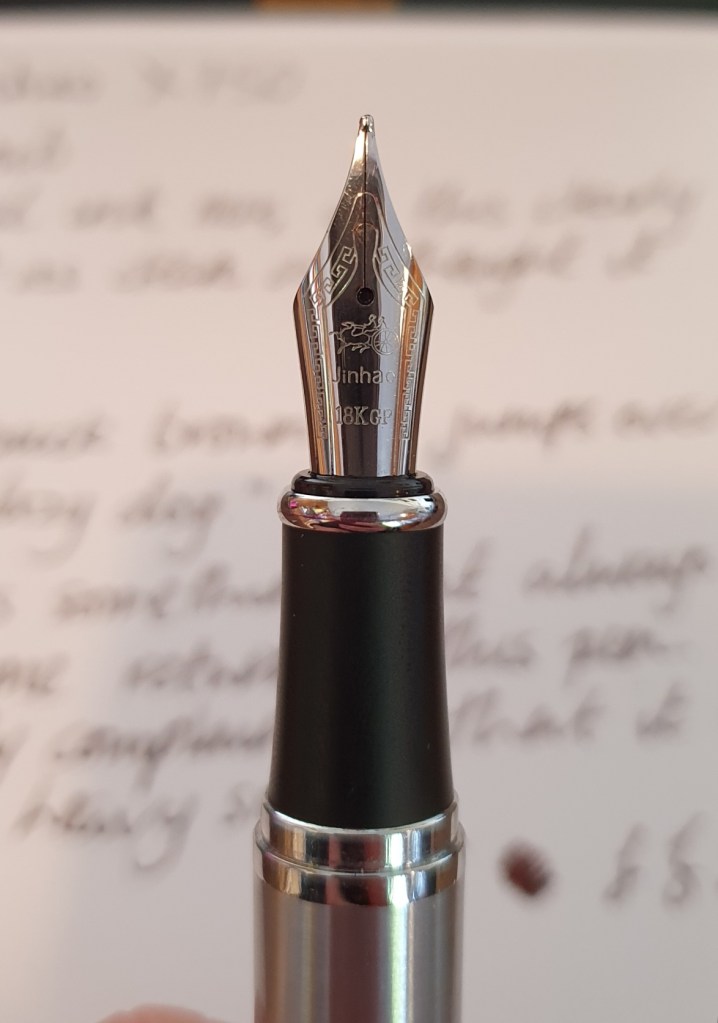
The Jinhao x750 is a big pen. It is a heavy pen. It feels reassuringly well made. It is also a very cheap pen. It is, clearly, a generic, ‘luxury pen’ style pen in the classic cigar shaped mould. What is there not to like? I feel it really is one of those fountain pens that should be in every collector’s collection. It is a complete workhorse, and is rock solid.
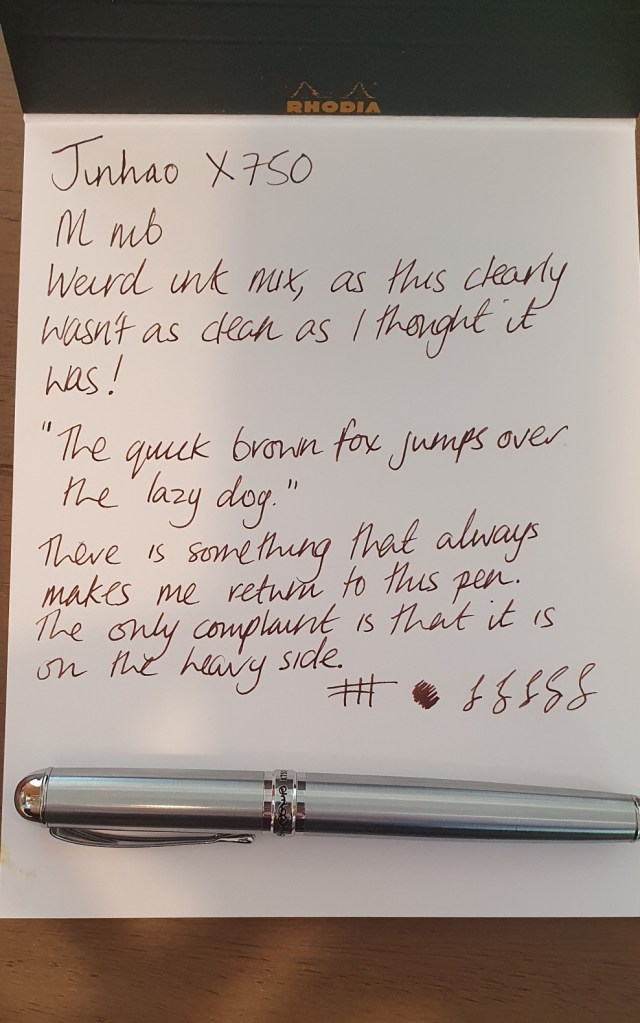
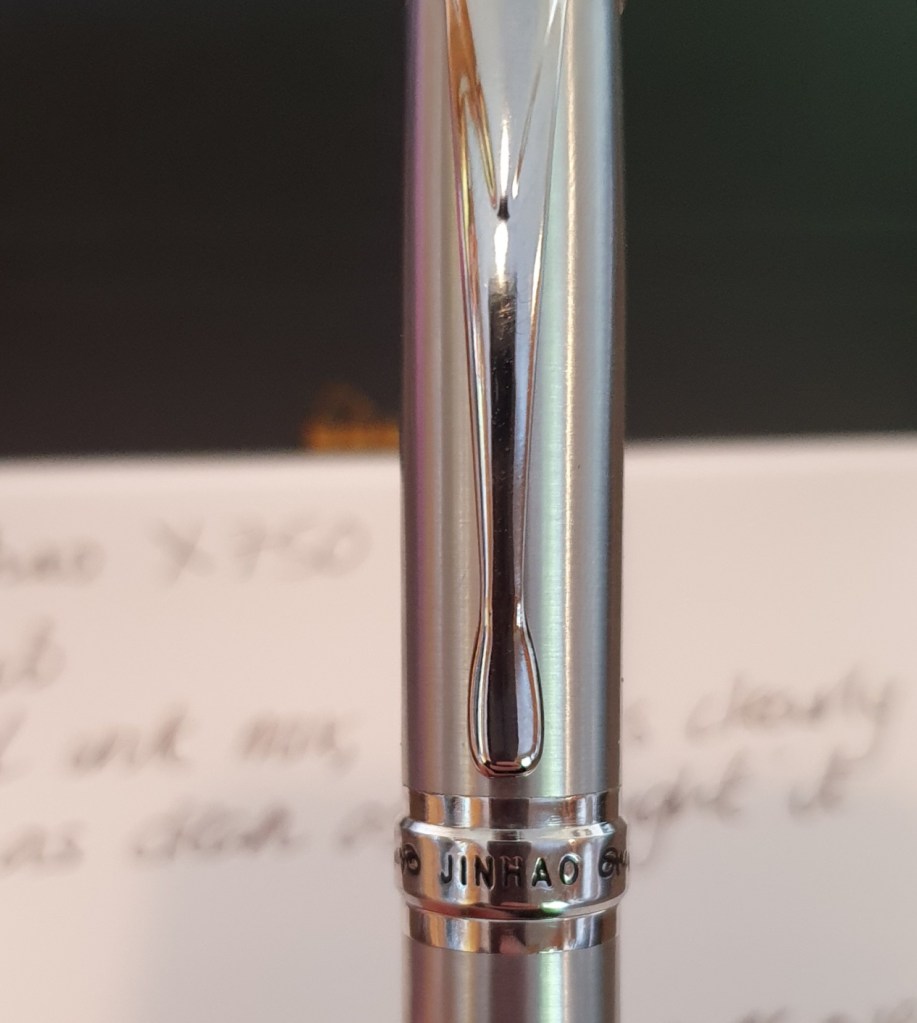
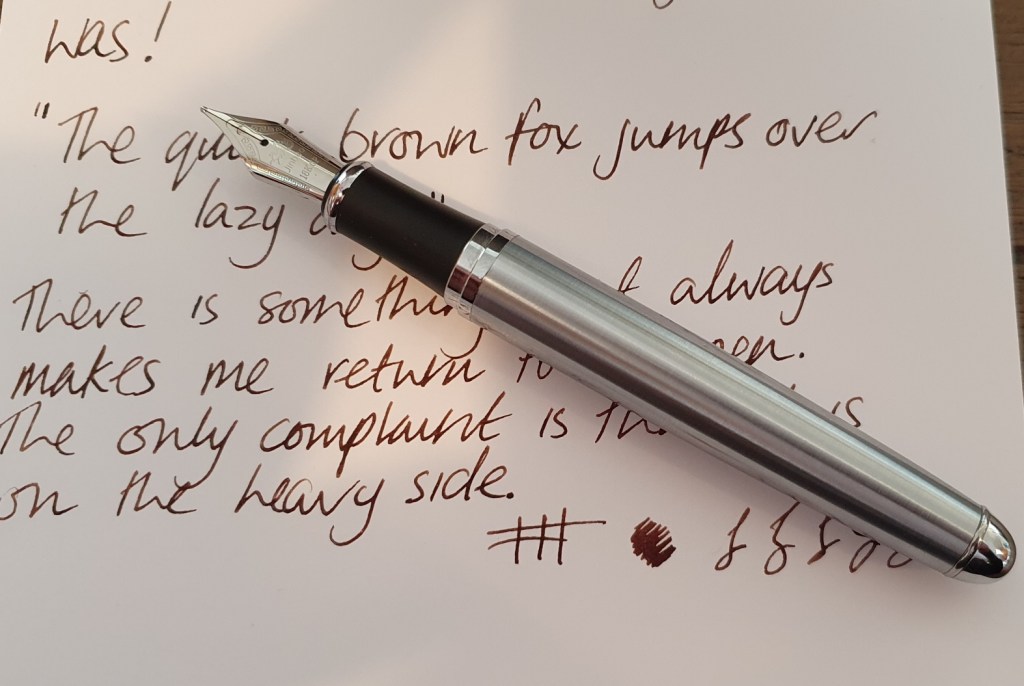
Purchase Price: £2.99 (eBay)
The Good:
- Inoffensive design (this stainless steel version, at least – gaudy versions abound)
- 18 KGP nib (I’m not too sure of the veracity of this claim by Jinhao, but they don’t state it on all of their nibs, so it could be true)
- Really smooth medium nib, that lays down a juicy line of ink
- Accepts no. 6 nibs
- Accepts standard international cartridges and converters
- Decent build quality
- Excellent price / quality ratio
The Not So Good:
- Uninspiring, generic design
- Big, heavy pen – not great for long writing sessions
- Tends to dry out quickly if unused for a while
- Some reports of poor nib QC
- I have only seen these pens in M, which happens to be perfect for me, but might not suit everyone
Essentials:
Capped: 14cm, Posted: 16cm, Weight: 39g
TWSBI killer?
Until the Wing Sung 698 came along, decent demonstrator piston fillers at a reasonable price were the domain of TWSBI. With the standard Diamond 580 and budget Eco pens, TWSBI pretty much had this segment of the market wrapped up. This pen to me is a fusion of the TWSBI Diamond 580 and the Eco, but it verges more towards the 580 in terms of looks. I would say the 698 was like a child that strongly favours one parent in terms of appearance, but I think a better analogy would be that of a hybridised clone. The cap shows slight differences, and I actually think I prefer the cap on the Wing Sung model, it is more in keeping with the overall transparent design. That said, there’s absolutely no getting away from the ‘heavily influenced’ design of this pen. At the same time, you have to hand it to Wing Sung. It is as though their designers took a look a TWSBI and thought, “Those are great pens, how can we make them a little better and a little cheaper?”
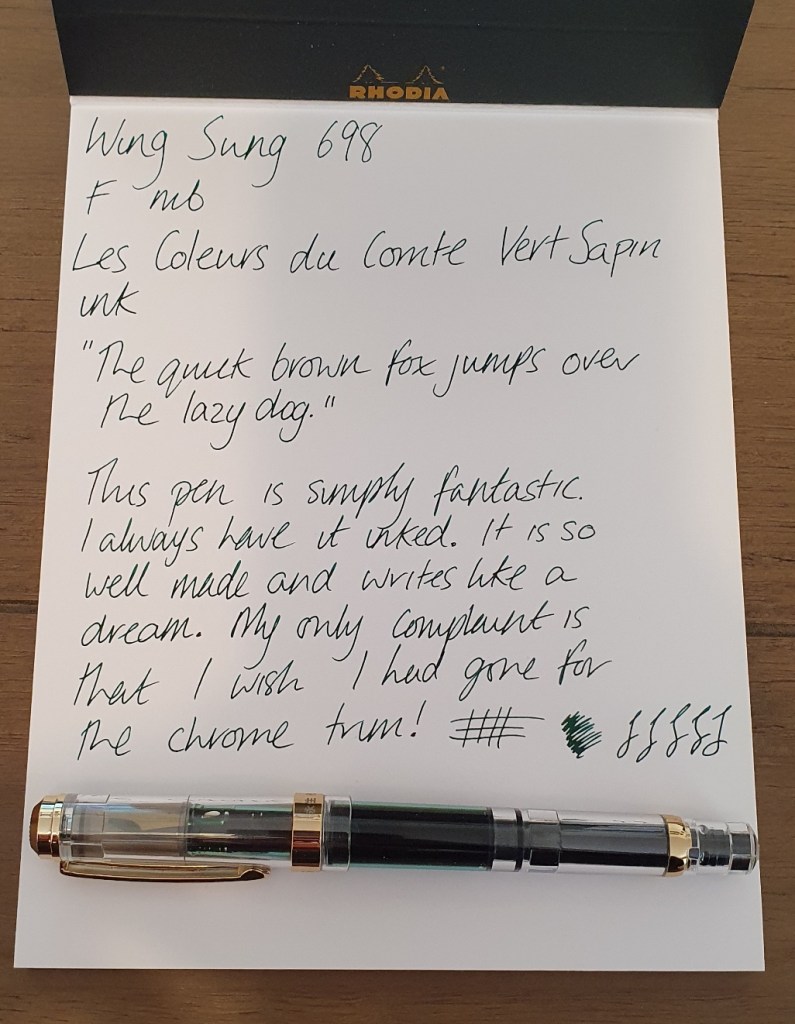
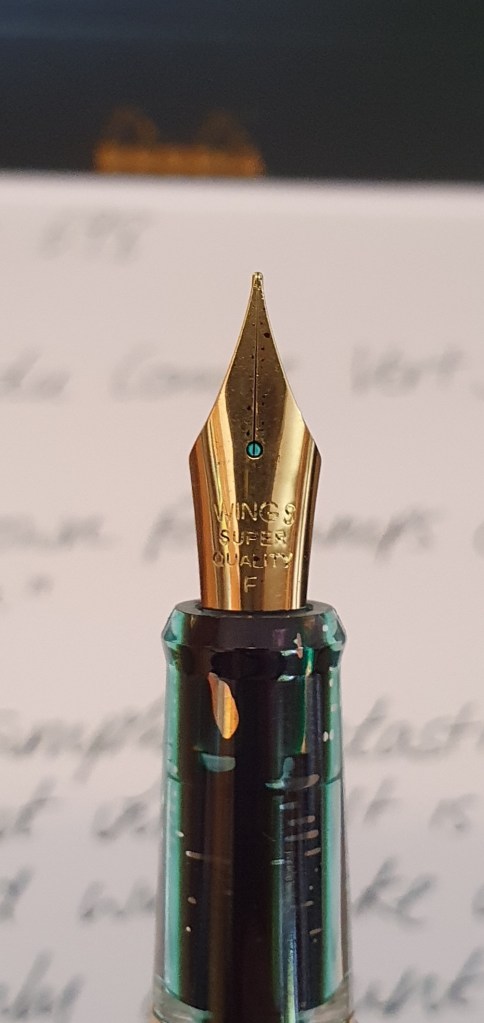
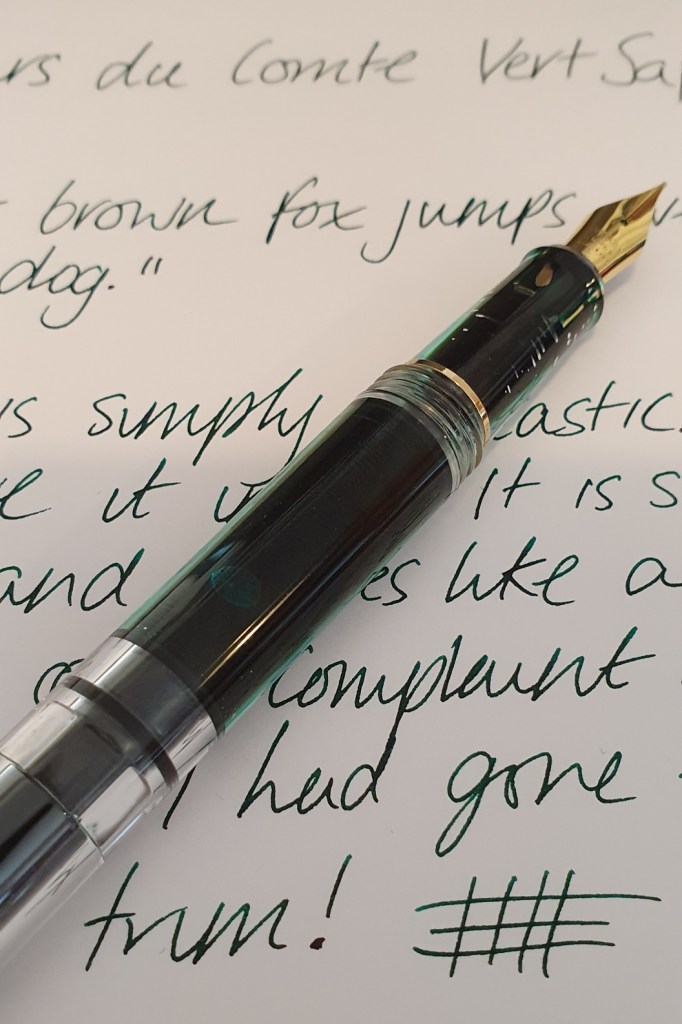
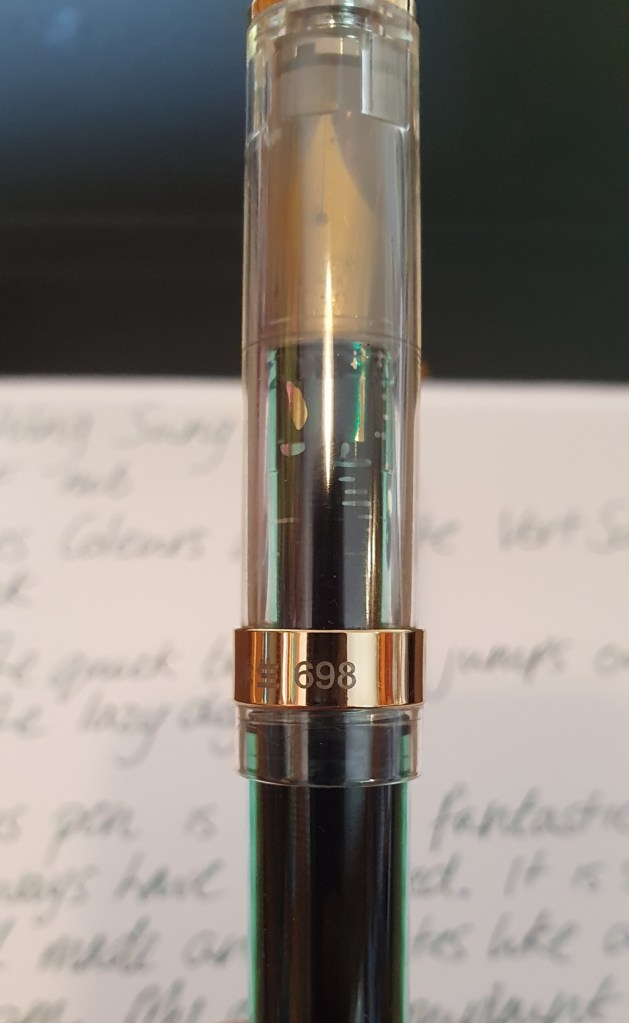
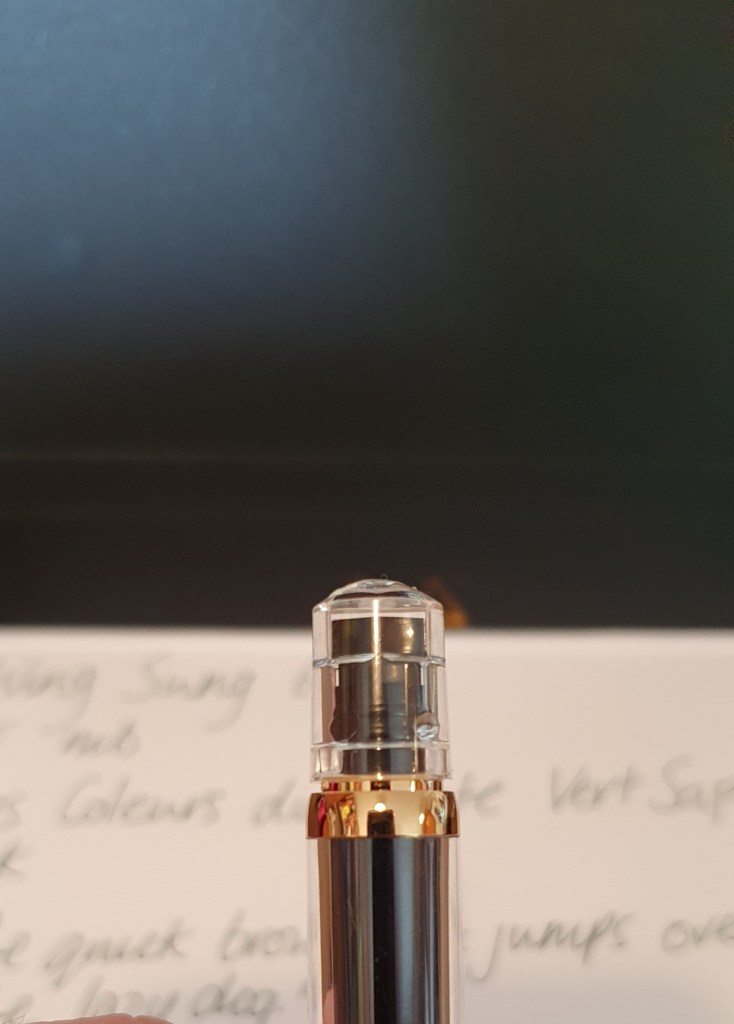
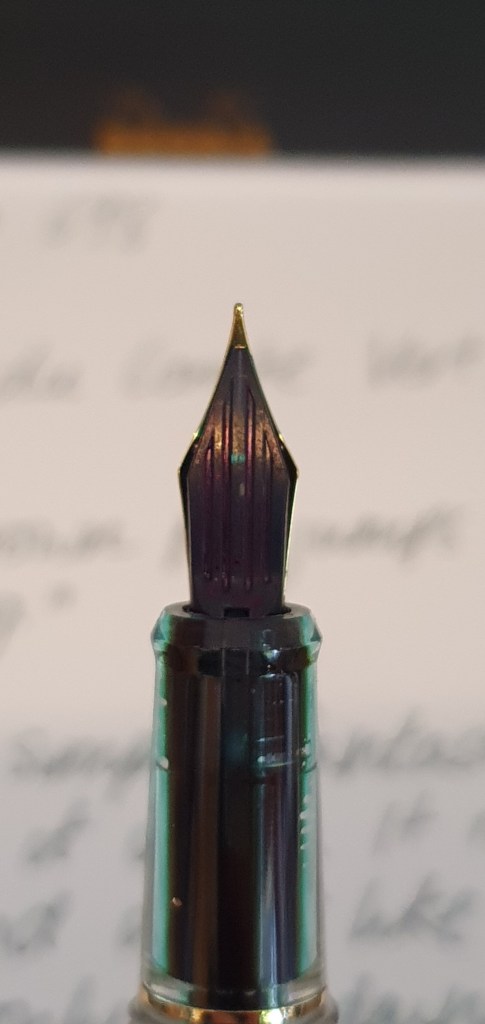
Purchase Price: £19.99 (Amazon)
The Good:
- Great build quality – many have commented (and I happen to agree) that the acrylics used feel far less brittle than those used in TWSBI pens
- Piston filler that works well and has a locking cap
- Transparent feed – this is very cool and adds to the overall look
- Excellently smooth nib
- Looks great
- Takes standard no. 5, and cheaper Pilot, nibs
The Not So Good:
- Honestly, I am struggling here. For the price, this truly is an excellent pen if you can see past the blatantly ripped off design.
- Doesn’t post
Essentials:
Capped: 14cm, Posted: n/a, Weight: 24g
When a Custom Heritage 823 isn’t a Custom Heritage 823
Let’s start by dealing with the elephant in the room, well, probably not – because the title leaves nothing to the imagination: the Wing Sung 699 is basically a copy of the Pilot Custom Heritage 823. But it is a really, really good copy. It also costs less than a tenth of the price of a Custom Heritage 823. Admittedly, it lacks a gold nib and probably, if we are being completely honest, a bit of the finesse of a Pilot pen. This brings us back to the cost, with the Custom Heritage 823 being 10 times more expensive than the Wing Sung 699, something has to give.
That is not to say that the Wing Sung is a bad pen, far from it, but it is important to acknowledge that with the price differential between the two pens, expecting a like for like replacement is unrealistic. What you get with the Wing Sung 699, however, is a fantastic pen in its own right. And with that, I think I’ll proceed straight to the pros and cons of this fabulous pen. For those who want to know more about the nitty gritty of the similarities and differences between the Custom Heritage 823 and Wing Sung 699, 7he Daniel did a great comparison between the two pens, which can be read here.
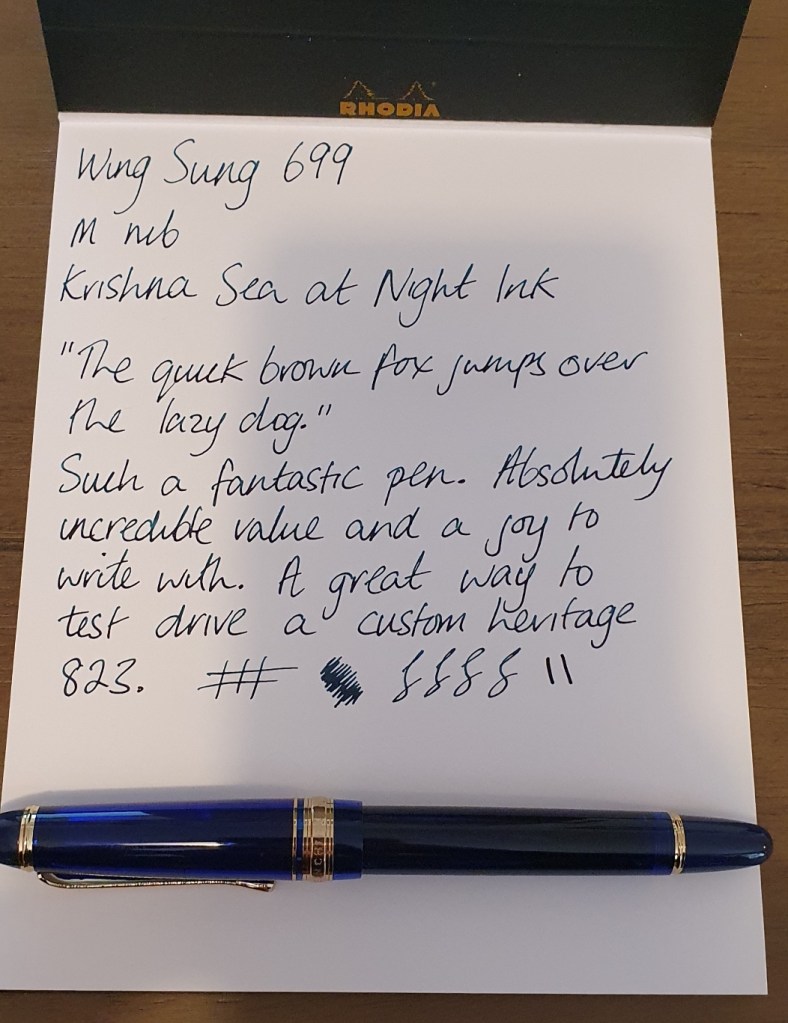
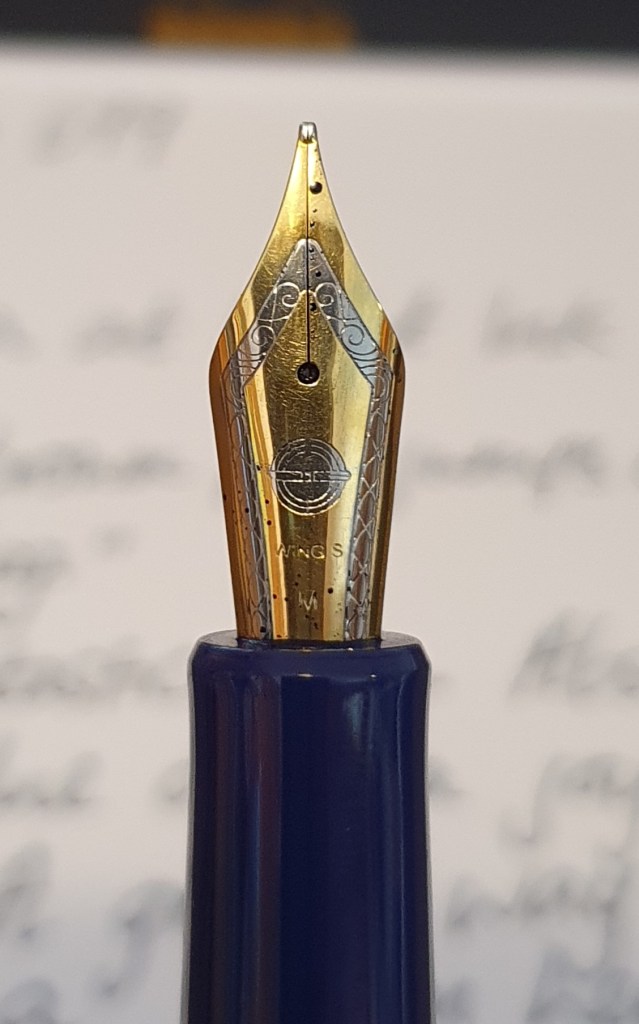
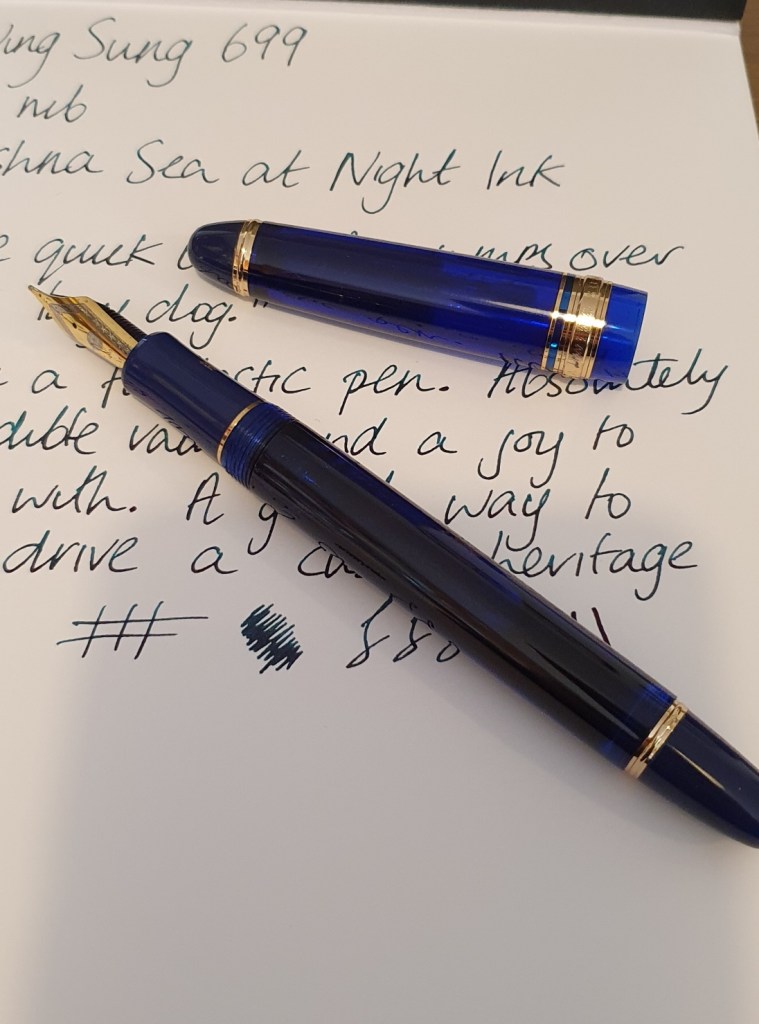
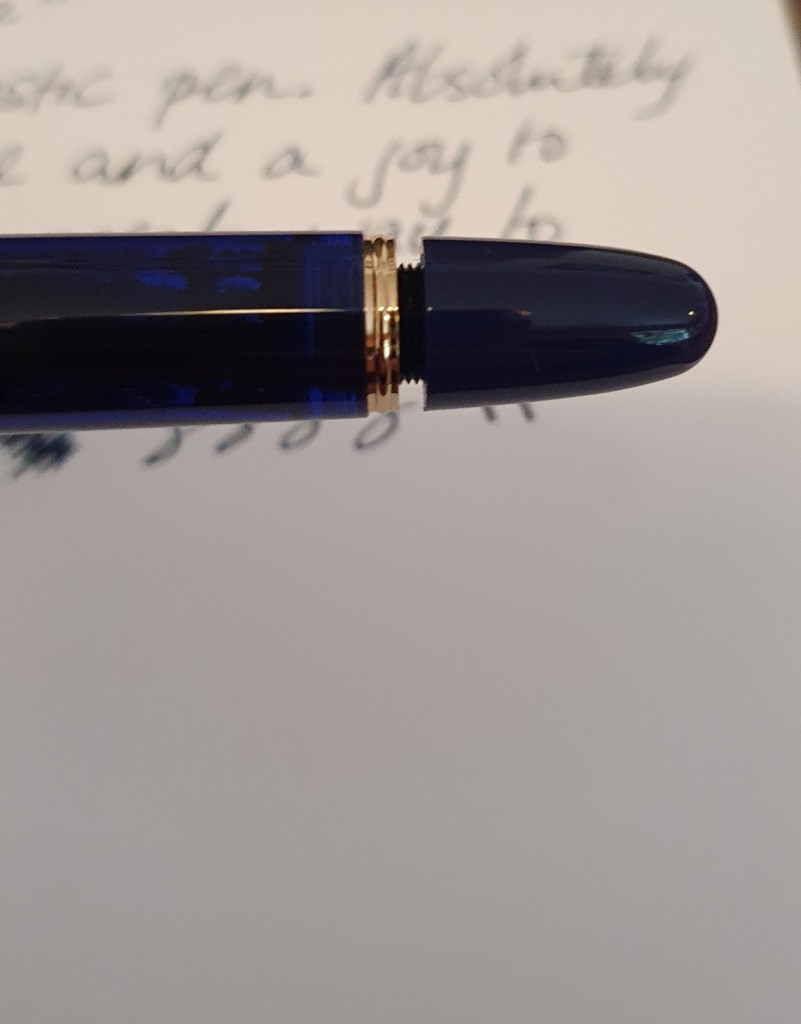
Purchase Price: $19.90 (eBay)
The Good:
- Beautiful looking pen
- Vacumatic filler with cut off
- Comfortable to hold
- Gorgeous, juicy two tone nib (in medium) with a little bit of give
- Excellent build quality
- Easy to disassemble
- Beautiful looking pen
The Not So Good:
- Some reports of issues with blind cap needing to be unscrewed to allow sufficient ink flow for longer writing
- Non-standard nib, although apparently some third party nibs can be used in this pen
Essentials:
Capped: 15cm, Posted: 16cm, Weight: 29g
The Chinese Exclusive Pilot
The Pilot 78g was one of those models of pens that had a cult following. It was a nice size, cheap, lightweight, came in a range of nib sizes and had a 22k gold plated nib that met almost universal acclaim. I don’t think I read a bad review of the pen. Usually a few [insert your currency of choice here] cheaper than the Metropolitan, and with (IMO) a better nib, it was touted as an ideal school or beginners pen. Then Pilot discontinued it and the prices of remaining units increased. It seems that there was demand for this pen from the world’s largest internal market, however, and thus the Pilot 78g+ – a Chinese market exclusive- was born.
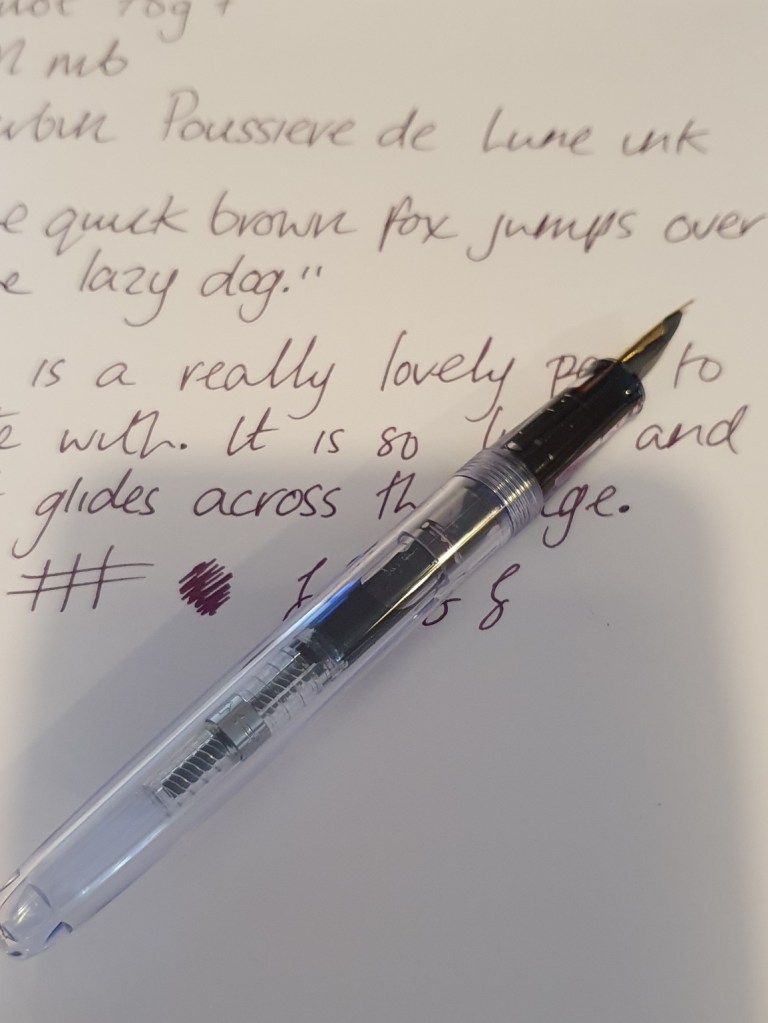
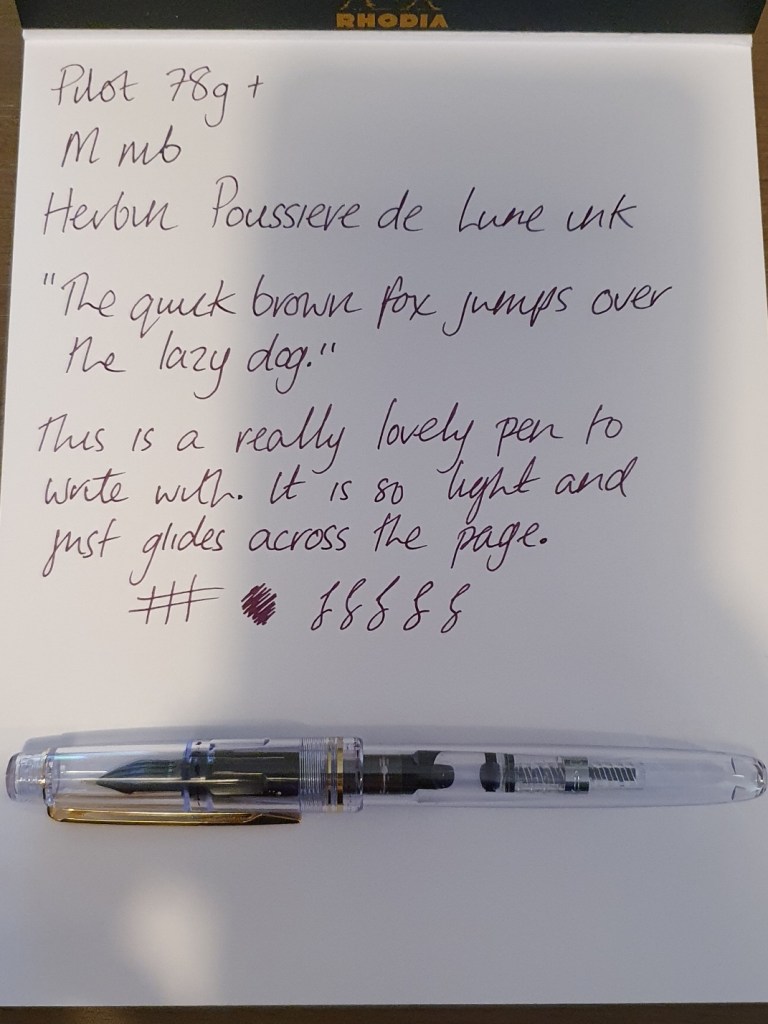
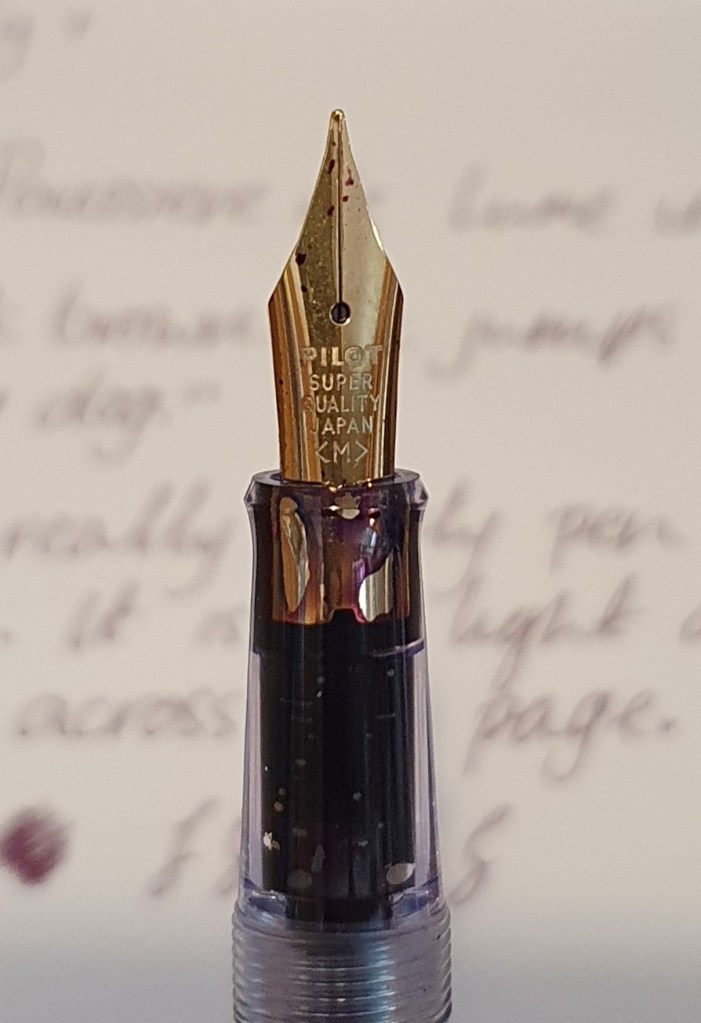
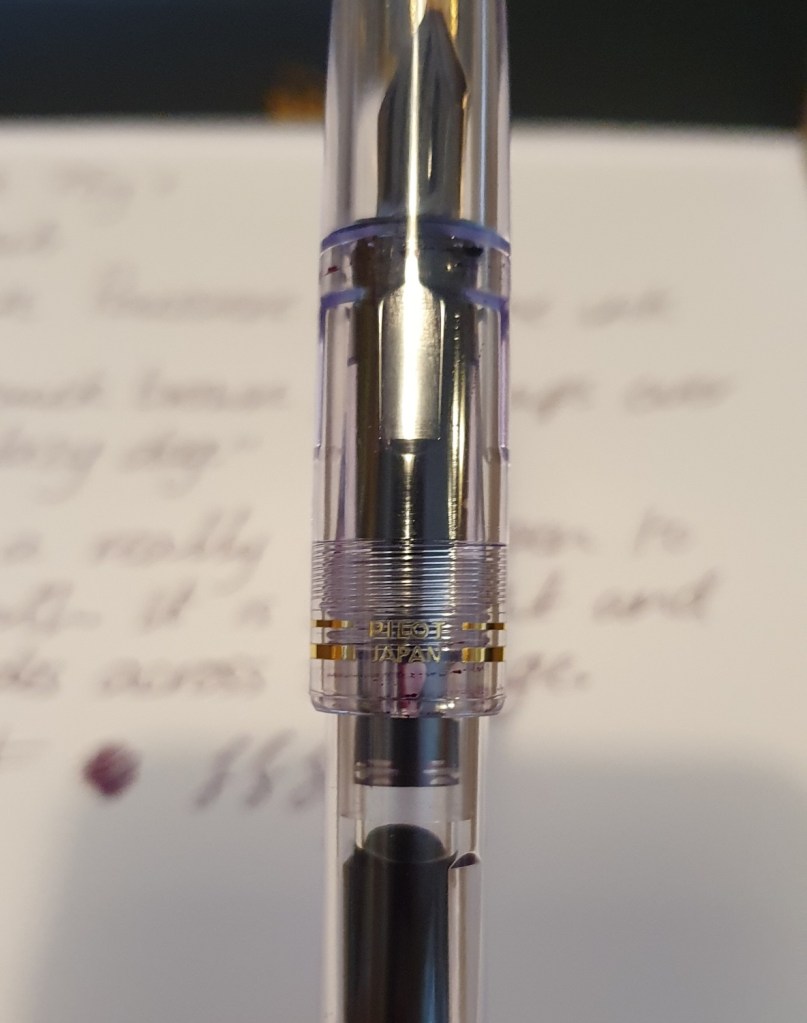
Purchase Price: €14.71 (AliExpress)
The Good:
- Comes in a range of colours and nib sizes
- Lightweight
- Includes converter (con40)
- Decently springy 22k gold plated nib available in EF-B
- Looks decent
- Good build quality
The Not So Good:
- Slightly more expensive than the original 78g
- Stub like BB nib from original no longer offered
- Reports of lower build quality than original 78g with plastic more prone to scratching
- Thinner nib than original model, which adds bounce, but adds to fragility
Essentials:
Capped: 13.5cm, Posted: 15cm, Weight: 12g
All Showing Eye(dropper)
Moonman are a relatively new name on the Chinese pen scene. They offer pens that tend to be a little more expensive than the usual offerings, but the advantage of this is that their offerings are of higher quality than average. This is especially true of the Moonman M2, a truly lovely pen. A torpedo shaped transparent eyedropper (ink is filled into the body of the pen manually by use of an eyedropper), this smartly presented offering has rightly won many plaudits.
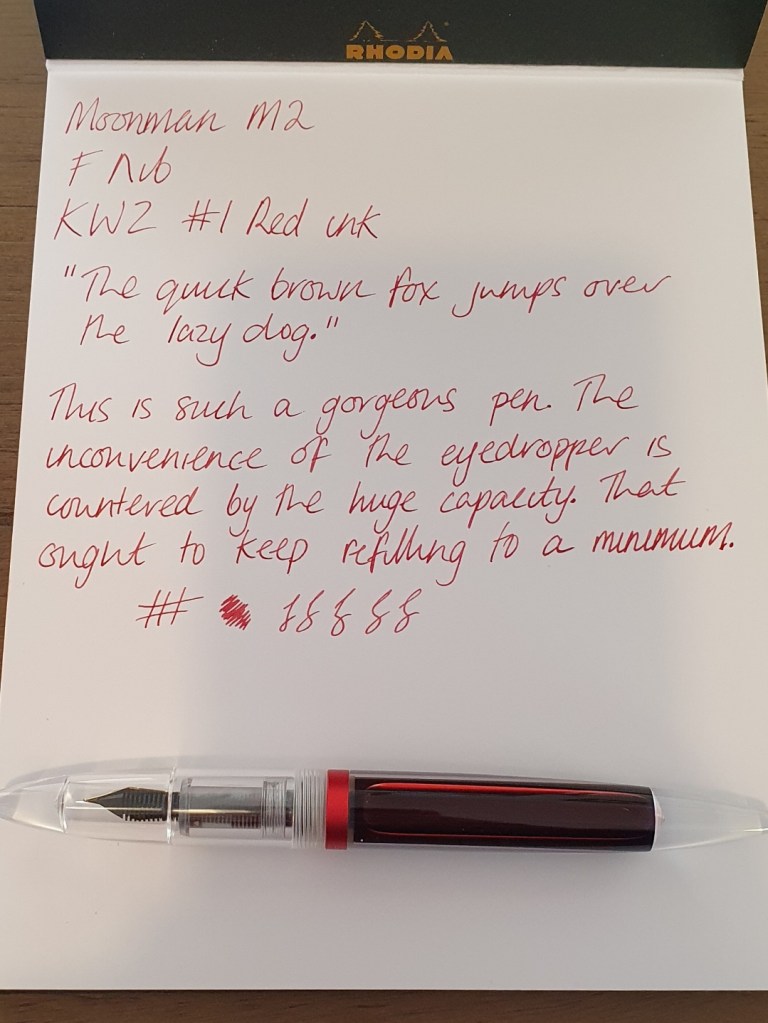
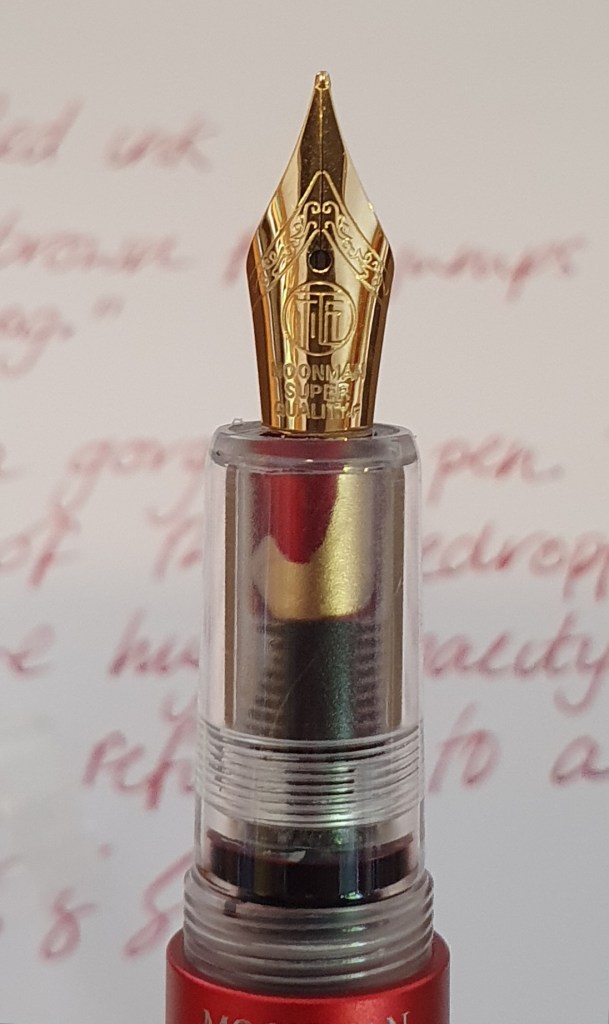
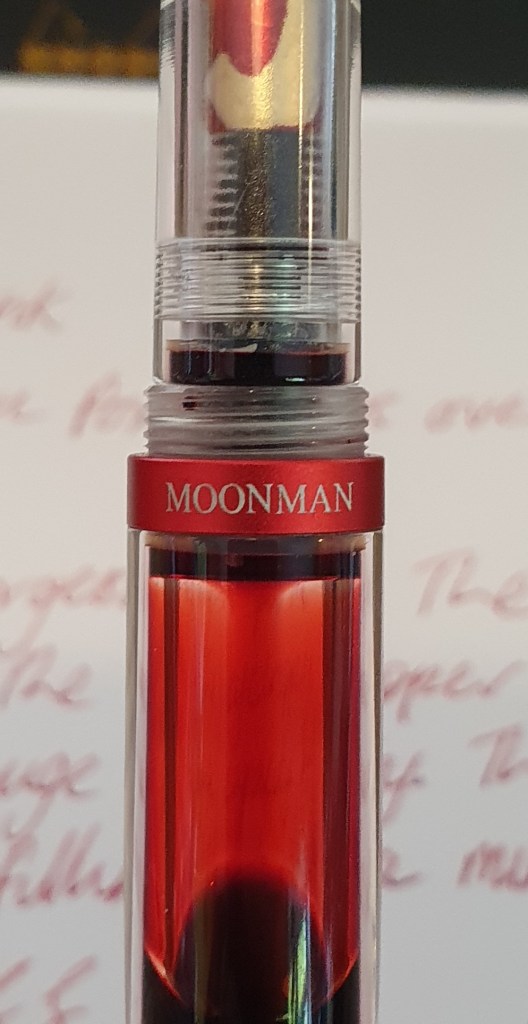
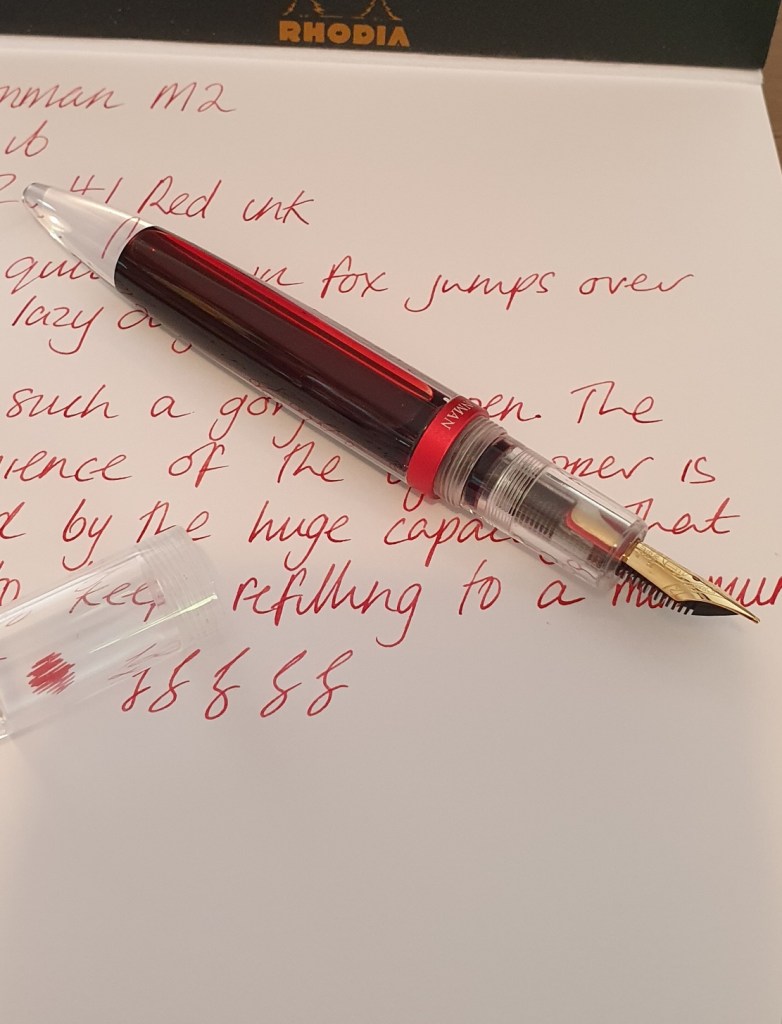
Purchase Price: £17.98 (Amazon)
The Good:
- Gorgeous design
- Excellent build quality
- Flawless acrylics used
- The supplied nib is a pleasure to write with, straight out of the box
- Huge (almost 3ml) capacity
- Well packaged, supplied with high quality eyedropper
- Takes no. 5 nibs
- Spare nib units are available
The Not So Good
- Only available in EF and F
- Tendency for the pen to ‘burp’ as ink levels get lower
- Does not post easily
- No clip, so can roll off your desk or writing surface of choice
Essentials
Capped: 14cm, Posted: 15.5cm, Weight: 15g
A derived Lamy 2000
The Kaco Edge often gets called a Lamy 2000 rip off, and in my opinion, this is unfair. Yes, it uses the same Makrolon material that the Lamy pen does, and it also features a brushed finish. But that’s where the similarities end. I do not see the same accusations made when a mainstream pen manufacturer releases a cigar shaped polished black acrylic pen, for example. Besides which, the Kaco Edge is a cartridge converter with a stainless steel nib and boasts a rather idiosyncratic clip, from which its name is derived. With good looks, a decent German nib and a low price point, the Kaco Edge is a perfect bargain buy.
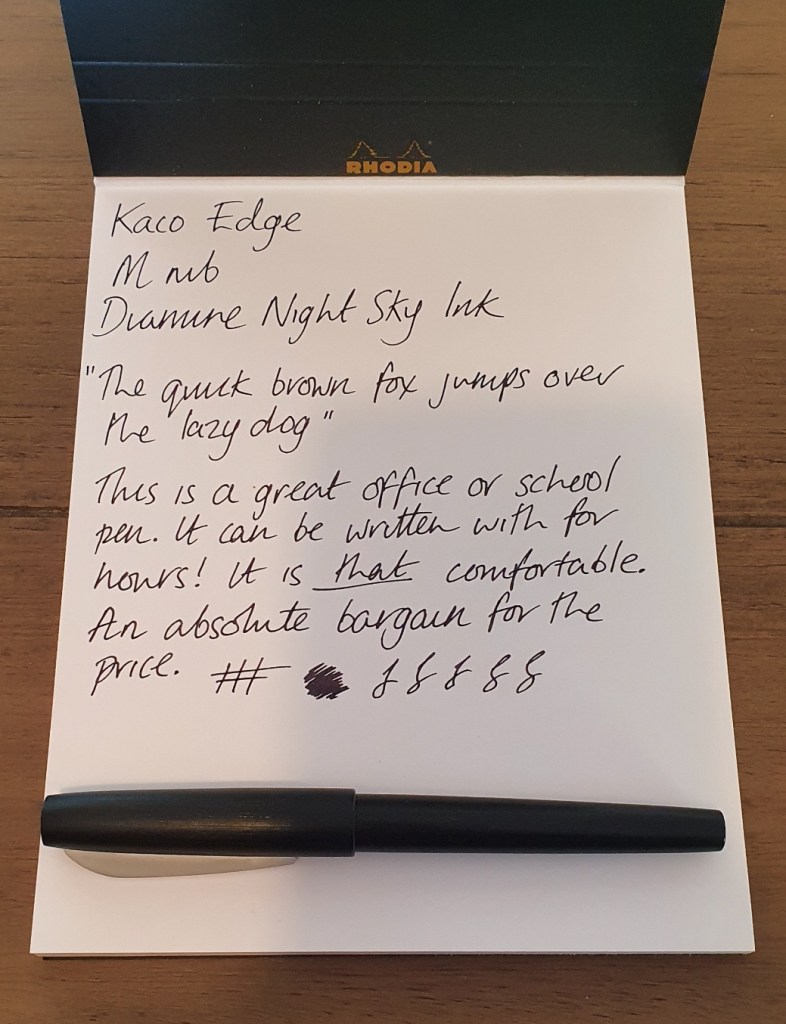
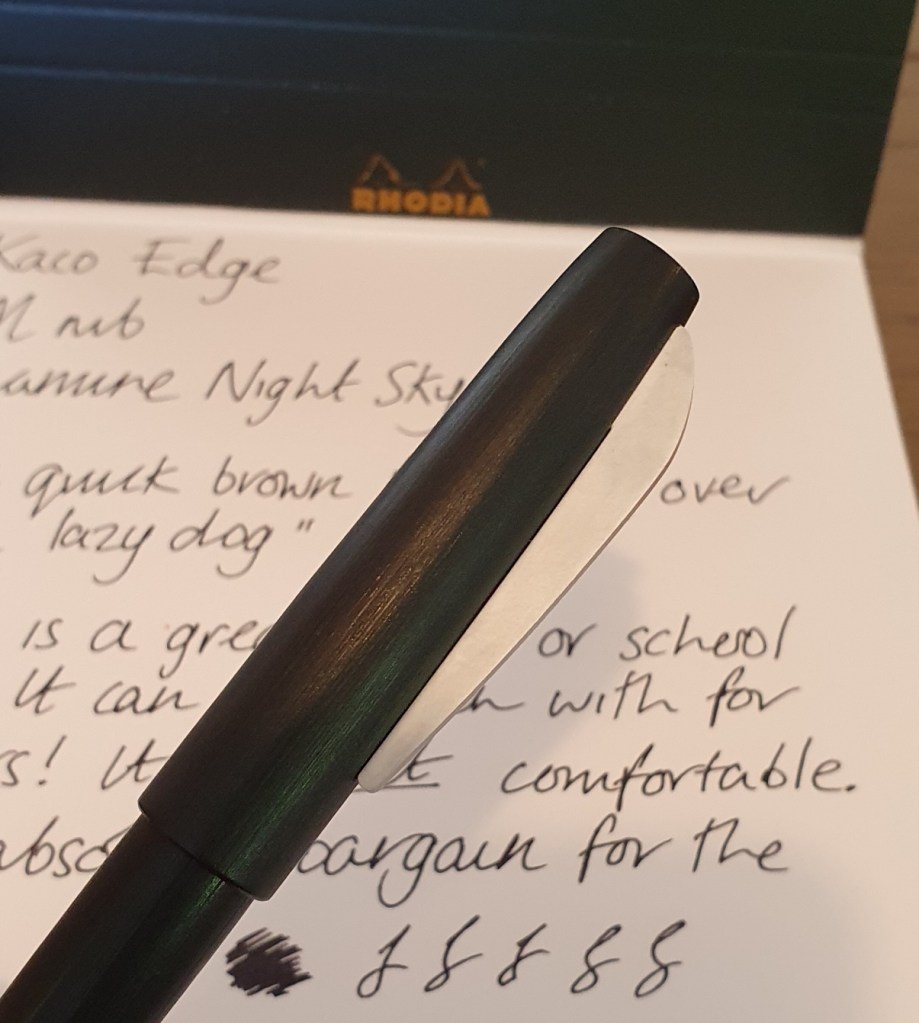
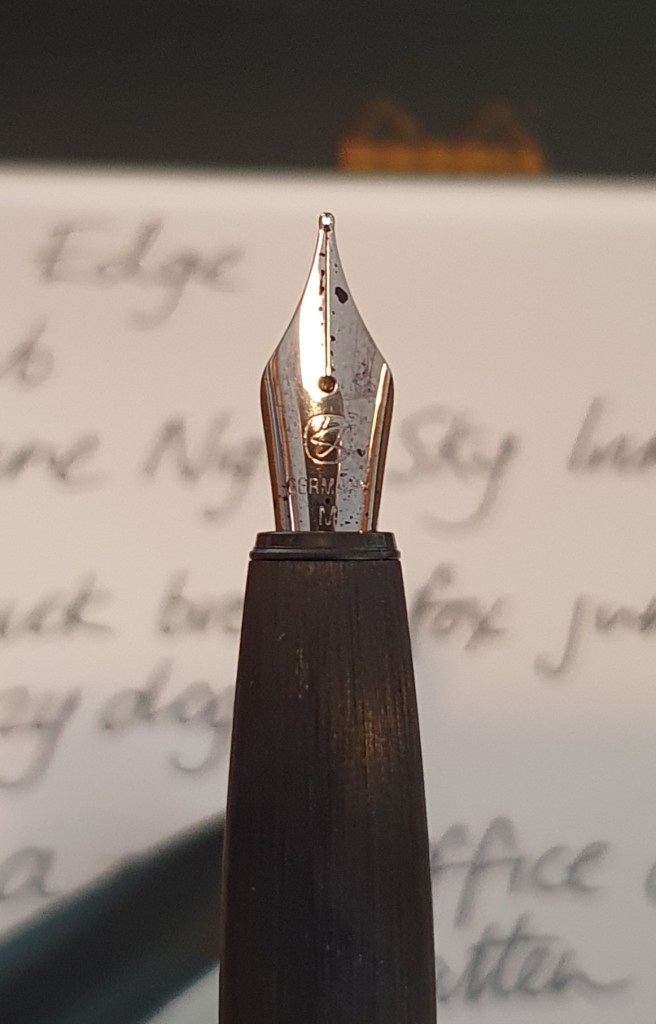
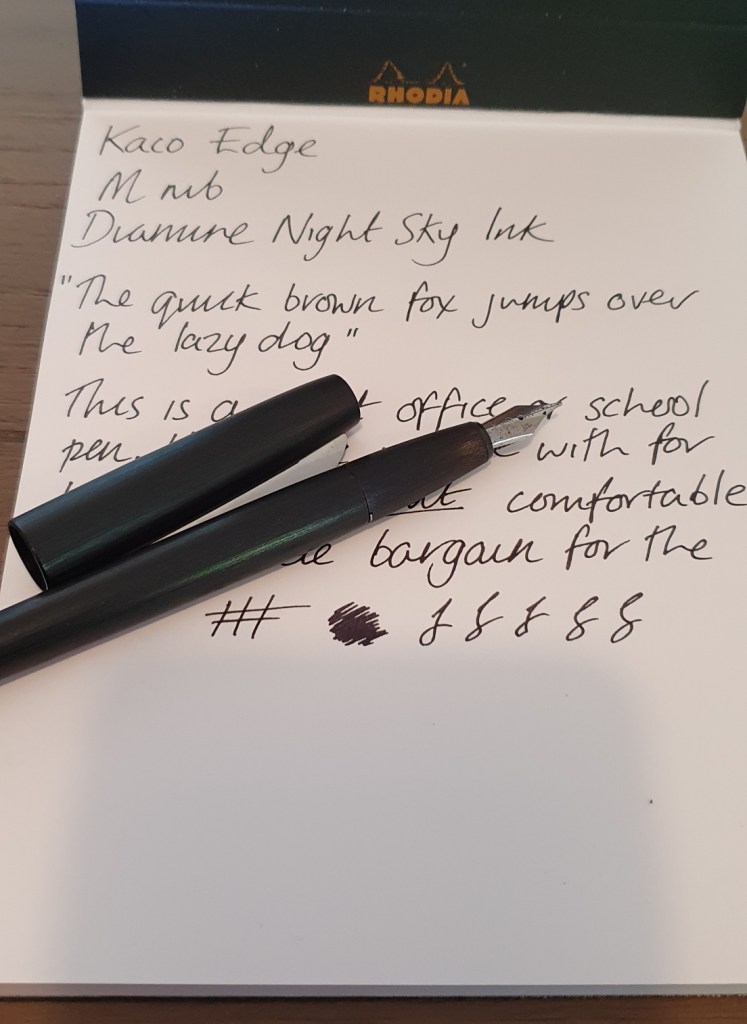
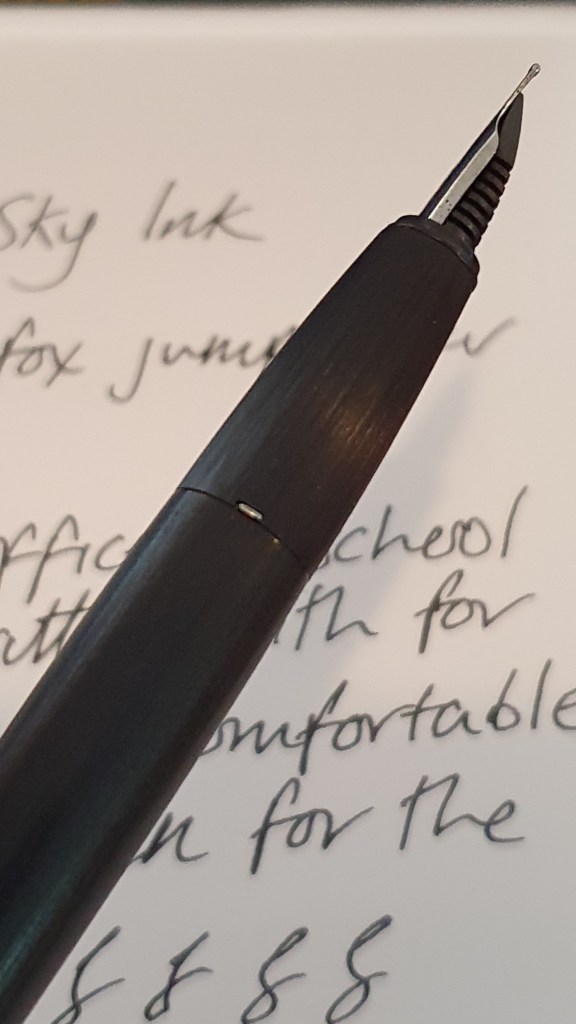
Purchase Price: £12.99 (eBay)
The Good:
- Very attractive pen
- Brushed finished makes for comfortable writing sessions
- Lightweight
- Supplied Schmidt nib and converters are very good
- Takes standard no. 5 nib
- Good build quality
The Not So Good:
- The clip design is not for everyone
- There have been some reports of the cap cracking due to the clip, although this issue has been supposedly rectified in later production runs
- Some reports of ‘meh’ nibs, especially in EF & F.
Essentials:
Capped: 14cm, Posted: 15.5cm, Weight: 24g
Et Fin…
Apologies for such a long post, yet I feel we have barely scratched the surface of good bargain buys from China. As I wrote above, this list is by no means comprehensive, so if you have any recommendations, by all means let me know. A notably omission from this list is any Penbbs offering. While I own, and love, a few Penbbs models, none of them have been bought for under £20/$25.
 Fountain Pen Writinerary