Of course, there is no right way or wrong way go about collecting fountain pens. As I previously wrote about, instead of buying a similarly or slightly higher priced pen, I opted to buy a few cheaper models of a similar or lower price to the Lamy Safari. And, as I also stated, I now own only one of those models bought during that period.
Does this mean that I went about things the wrong way and chose awful pens? Well, I did chose awful pens for me, but that is not to say that someone else might have had more luck, or enjoyed those pens more than I did. All I can say is that the pens I chose were not great for me.
What I should have done is buy the pen I am going to write about today, the TWSBI Eco, or more specifically, the Eco-T (the triangular gripped variant of the more standard Eco).
What’s the deal with TWSBI?
So TWSBI (pronounced in English as ‘twiz-bee’) are a Taiwanese manufacturer of fountain pens. The name is, according to TWSBI themselves, an acronym of the phrase, “Hall of Three Cultures”, or “San Wen Tang (三文堂)” in Chinese. A long time manufacturer of OEM pens under the name Ta Shin Precision, in 2009 they decided to go into start selling pens under their own name, and thus, TWSBI was born.
While early models of their pens had already gained a name for the manufacturer as a disruptive force in the fountain pen industry, it was in 2015, with the launch of the ECO that TWSBI became a recommendation for budget, starter fountain pens. For more details, please see Pen Economic’s excellent brand analysis of TWSBI, dating from 2015. As Proctor Beans states in the post, at the time of the release, TWSBI were one of the few manufacturers offering piston filling fountain pens at such a low price point.
What’s a piston filler?
Simply put, a piston filling pen uses the pen’s body as a kind of giant converter. The ink is drawn into the pen’s body by way of an internal piston. The knob of the piston is typically at the end of the pen, and the ink is held internally instead of in an external converter.
The main advantages of this are increased capacity and usually less mess (as the knob to move the piston is normally at the end of the pen, and therefore less likely to be near the ink, and the user’s fingers!) In transparent, or demonstrator, pens it has the added advantage of looking cool. This video from Pure Pens demonstrates how to fill a TWSBI Eco (or any piston filler, for that matter).
Why not TWSBI?
So, what made me eschew the TSWBI Eco and pursue the route of false economies that I have previously blogged about? Looking back, and knowing what I know now, I should have just bit the bullet, and bought the TWSBI Eco.
I think cost played a part. When you are new to fountain pens, especially after coming from the world of disposable ballpoints, fountain pens seem expensive. Undeniably, they are more expensive than disposable ballpoints. And, on the whole, a fountain pen is often more expensive than its reusable ballpoint counterpart. Before regularly using and collecting fountain pens, I had mainly utilised disposable ballpoints to fulfil my writing needs. I had been gifted a few nice ballpoints over the years, but for the most part, I was ignorant as to the cost of all non-disposable pens. The €20 I paid for a Lamy Safari, on top of the €7 for a converter and the additional cost of ink was a huge step up from a disposable ballpoint, at time. With that mind set, paying an additional £30 for a TWSBI Eco seemed to be an extravagance – especially when I thought that I could explore the world of fountain pens in a budget conscious manner. I think I have now disabused myself of this notion.
Another reason for me not buying an Eco was I remember reading somewhere that piston fillers were not ideal starter pens due to their use of pistons rather than cartridges. I suppose there is some merit to that statement, as not all fountain pen users fall down the fountain pen and bottled ink rabbit hole. The mechanism itself, however, is I think demonstrably easy to use.
The Pen
The hard thing about writing a retrospective blog about pens that are established is that it is hard to be original. It is also hard not to be derivative. I try, therefore, to offer my thoughts on the pen and why it suited my (and hopefully your) needs at the time of purchase.
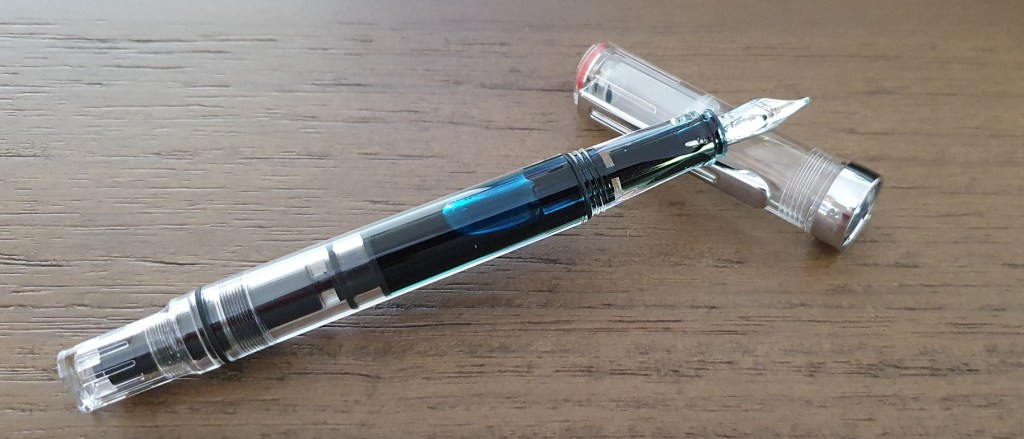
First of all, and probably one my number one concerns when choosing a new pen, is how it looks. The Eco and Eco-T look fantastic, to me. Opting for the fully transparent version, I love(d) the clean lines and the simplicity of the design. It is made from a single piece of durable high grade plastic. There is a minimalism to the pen that seems to scoff at the more aesthetic and mechanical complexity of some higher priced pens. Not that more intricate designs are necessarily a bad thing, it’s just that there is an appeal to the honesty and unabashed lack of pretentiousness featured in the Eco and Eco-T. The smooth screw-on cap sports a stainless steel cap ring and clip, which complement the overall design ethos, as well as a red TWSBI logo cap finial.
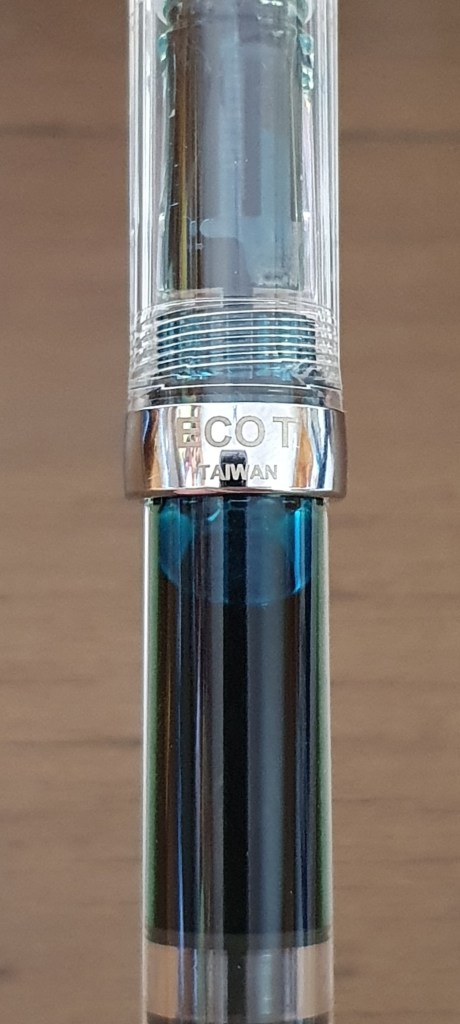
As a side note, the only difference between the Eco and Eco-T variant is that the Eco-T, first produced in 2018, features a triangular section and a differently faceted cap.
Detractors of the Eco often say that it looks cheap, which seems a bit harsh considering its price point, design integrity and build quality. A pen costing £30 / $30ish is never going to be made from premium materials, but the Eco is a well executed pen that more than punches above its weight in terms of features and delivery.
Of course, no model of pen is perfect; even the most expensive of pens suffer from quality control issues from time to time, and surely it stands to reason that products with higher circulation attract a higher number of complaints in absolute terms. What I can say is that I have never had an issue with my TWSBI Eco-T, and it still feels as rock solid now as it felt when I first bought it, almost 2 years ago. And it has seen a lot of use. Why? Simply because I love it. It’s always inked and always in use.
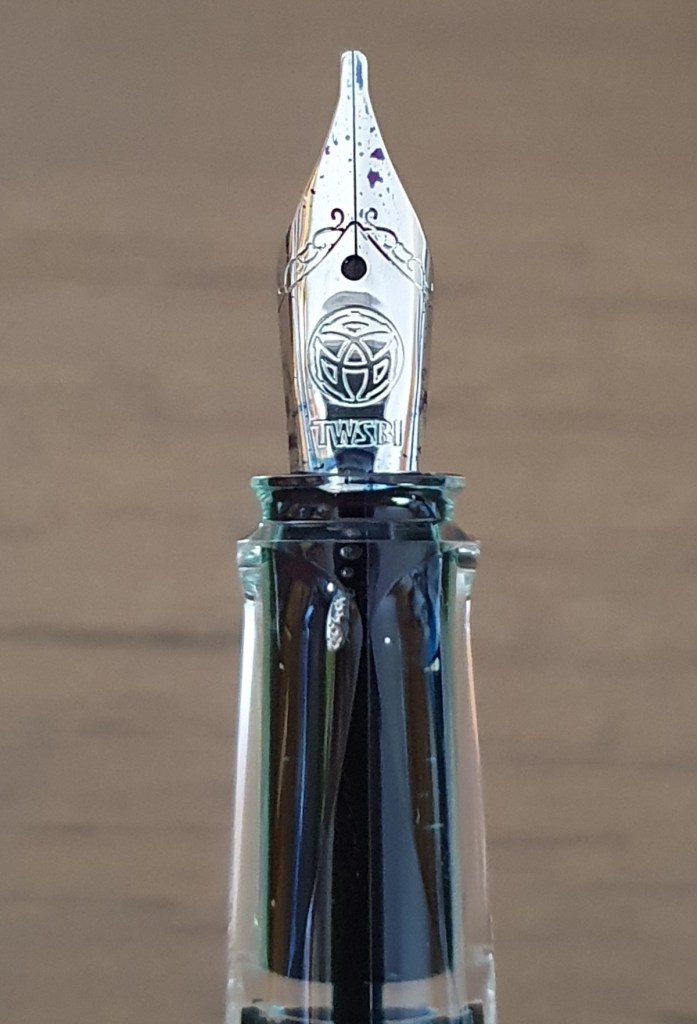
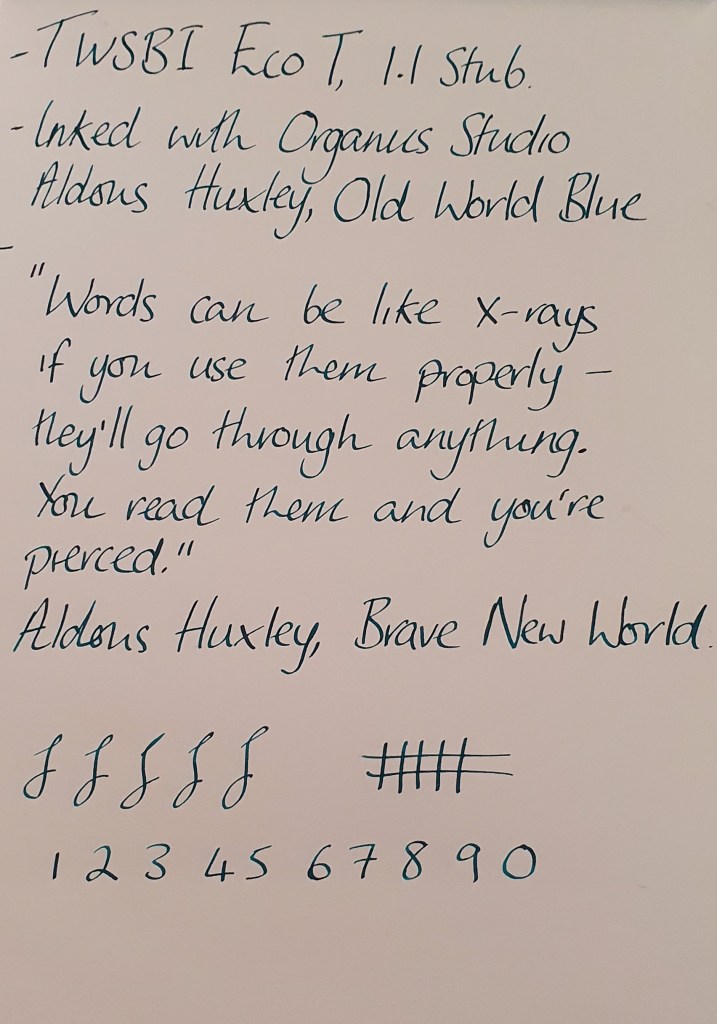
I chose a 1.1 stub nib when purchasing this pen and have zero regrets. The nib on this pen is fantastic! It is a smooth writer that has only improved with age. I have encountered no issues with the nib in all the time I have owned the pen. It has never skipped when writing, been scratchy or hard started. TWSBI reportedly use Jowo nibs for their pens, using a German nib means that the TWSBI pens are generally wider than other Asian pens. Something to consider if you prefer a finer line. Using a stub nib allows for line variation in writing and shading, depending on the ink used.
Other considerations
The TWSBI Eco comes with a spanner like tool and silicon grease. It can be completely dismantled for thorough cleaning, however, this probably not something one would need to do regularly. There are a ton of tutorials available on YouTube that demonstrate how to do so.
The pen can be posted – and is one of the few pens I enjoy using posted. The lightweight cap means that posting the pen doesn’t make it feel unbalanced.
At 14cm capped and 16cm posted, it’s an average size, but on the lighter side of things with an uninked weight of around 12g. The pen can hold roughly 1.75ml of ink, meaning it will last a good day’s writing without needing to be refilled.
Some people aren’t fans of ergonomic sections and are likely to be put off by the triangular shaped section on the Eco-T. The Eco boasts a more traditional section.
Also, if using in the office, be prepared for people to confuse it with a vape! Although, I’ll fully admit that this could just be something peculiar to me.
It comes in a range of colours, as well as transparent (although all versions are demonstrators). Limited editions are released periodically, in different colour schemes and materials.
Final thoughts
For the price, the TWSBI Eco really is a no brainer. I ought to have purchased one sooner than I did, but I have atoned subsequently. It has features and a build quality rarely found at this price point and is a joy to use.
Alternatives
TWSBI Diamond 580 / 580AL – the bigger brother of the Eco range of pens. The AL versions feature aluminium grips, connectors and rods. Slightly higher build quality and easily interchangeable nib units. Prices start at £45 / $50, more for AL and limited editions.
TWSBI Go – A newer budget model that uses a spring loaded piston to allow for single handed filling. Polarising design. Prices start at £20 / $19.
Penbbs 309 – this piston filling offering from Chinese collective of fountain pen enthusiasts is not without its issues, however, the designs and acrylics used are fantastic. Priced at $24 directly from Penbbs’s Etsy store.
 Fountain Pen Writinerary