When I first decided that I wanted to re-try fountain pens, I did the natural thing and Googled, “best starter fountain pen”. The results of which brought up a number of pen suggestions. I then went to a few bricks and mortar stores, explained that I wanted to ‘get into’ fountain pens and asked the staff for their recommendations.
When their recommendations corresponded to what I had read online, I then tested out a few of the suggested offerings and stumped up a then whopping (compared to ballpoints!) €20 for a Lamy Safari.
This very Lamy Safari, in fact.
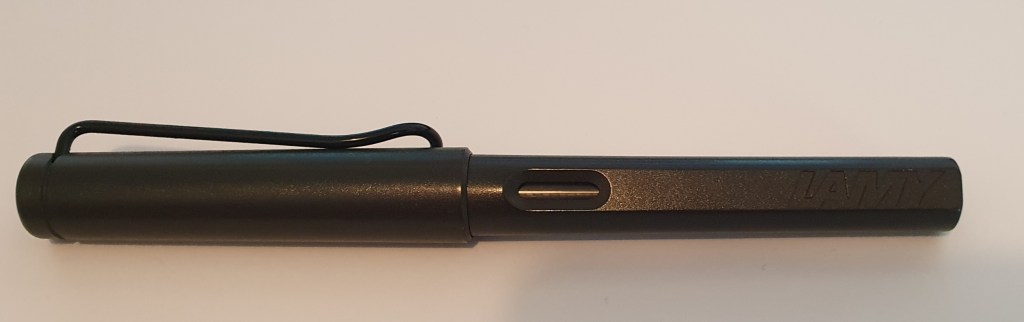
There was just something about it. I cannot really describe why I chose the Safari, it kind of felt right. But why?
Well, first of all, there is the material. It is made from a hard plastic called ABS (the same material that Lego bricks are made from), so you can be guaranteed that it is hard-wearing – as any parent can attest! But the material is warming to the touch and it felt more personal than some of the other pens that I tried.
The plastic construction also gives it a lightweight feel that belies its size. At 14cm capped, 17cm posted (when the cap is put on the body of the pen) and with a diameter of 1.2cm, it is quite substantial, certainly bigger than your average ballpoint! Yet, the complete pen and cartridge weigh less than 20g. Don’t let the weight or materials fool you though, this pen is well put together.
And then there is the ergonomically designed section (that’s the bit that you grip). It’s triangular. Now, some people hate this feature – in fact, it is the thing that puts them off buying the Safari – but for me, it was a Godsend. I had not held a fountain pen for so long that I wanted something that would help me grip my new pen properly.
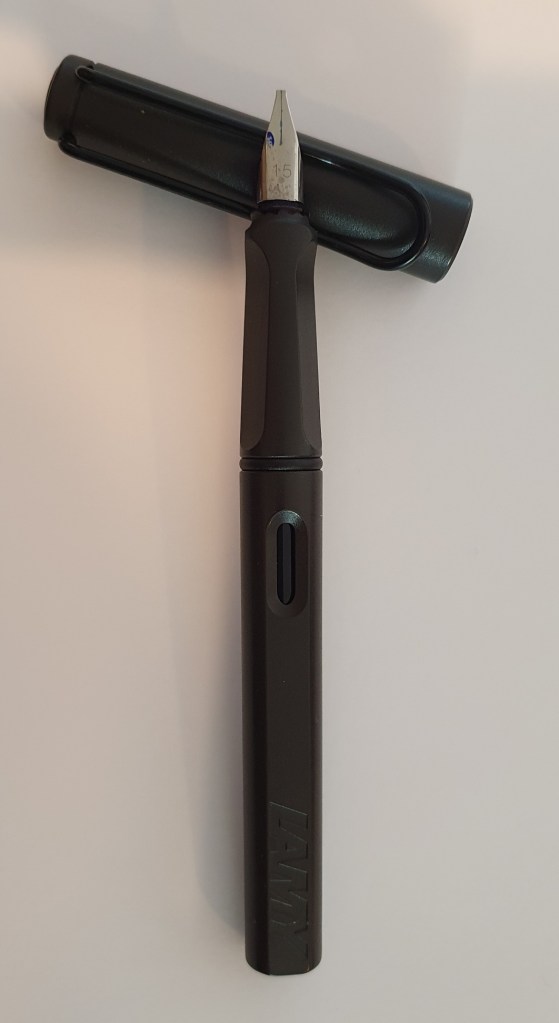
Even though the Safari comes in a host of different colours, I chose a dark colour, naturally. Serious, conservative, sophisticated… albeit on a pen designed for school children… because this was going to be my only fountain pen. No, really. I genuinely believed that.
Another thing that influenced my choice was the design. While the industrial, 80s, utilitarian design won’t appeal to everyone, I loved it. Sporting a light but resilient wire clip and a cut-out ink window, the Safari has all the features you want in a pen body. To me it was a breath of fresh air compared to the other offerings I had considered. Obviously now I am deeper into the fountain pen rabbit hole, I realise that the Safari is ubiquitous, but at the time, and compared to ballpoints, it was something different and something unique. Winner of the iF Design Award in 1994, the design is both distinctive and polarising.
Finally, I chose the Safari because it allowed for customisation. It can take cartridges, or it can use bottled ink via the use of a converter.
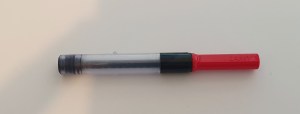
A converter is a cartridge shaped contraption that usually has some sort of pistol integrated. This allows you to use bottled ink. Why would you chose to do that? Well because while cartridges are readily available for most pens, Lamys included, the situation starts to get tricky thereafter.
Lamy, like many other pen manufacturers, use proprietary cartridges. At present, these are available in a total of 7 colours: blue (washable), black, red, turquoise, violet, blue-black and green.
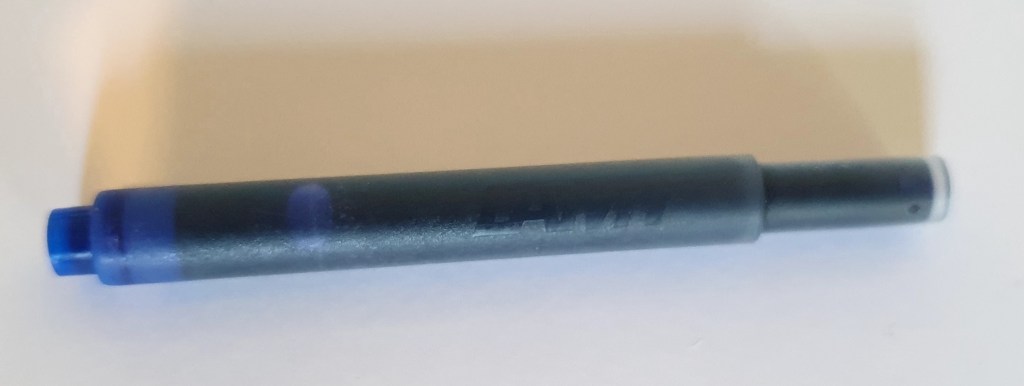
Compared to the poly chromatic offerings to be found in bottled ink, this is quite limiting. The only bug bear is that other manufacturers include converters as standard, whereas Lamy’s converter is usually purchased separately.
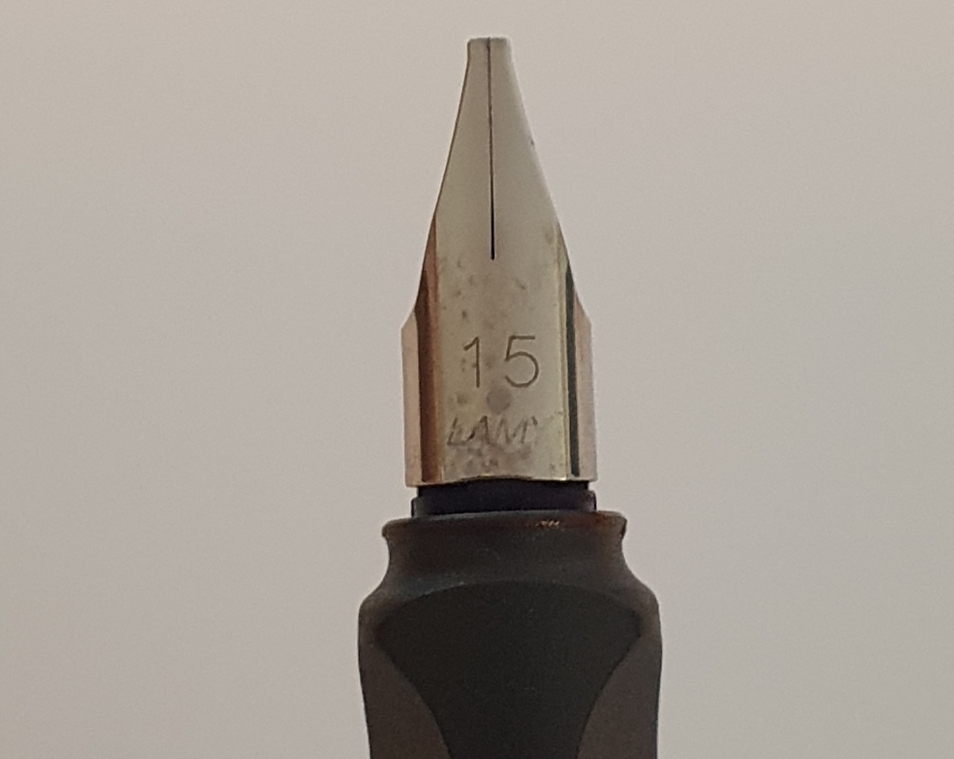
As well as allowing different inks via a converter, the Lamy Safari can be fitted with a choice of nibs; in a number of colours and in either steel, or should you desire, gold. I won’t go into full details here, but generally speaking gold nibs are more esteemed than steel and are, correspondingly, more expensive.
Standard fountain pen nib sizes are EF (extra fine), F (fine), M (medium) and B (broad). Stub nibs (typically those without a round ‘blob’ at the tip) are also available for many pens and most commonly come in 1.1 size, although more sizes are available and offerings do vary by manufacturers. Lamy, for example, offer EF, F, M, and B regular nibs, and 1.1, 1.5 and 1.9 size stub nibs. There are even left handed and oblique offerings available. For a more detailed explanation of different nib types, see here.
I ended up with a 1.5 stub nib with my pen. Stub nibs, also sometimes called italic nibs, allow for line variation when writing, being thicker on the vertical strokes, and narrower on the horizontal strokes. That said, it also depends on your handwriting style. Stubs can add an interesting flair to your writing and, I think that is what appealed to me.
*Caveat* – there are many more authoritative sources on various nib styles and how they can affect your writing, I do not claim to be an expert and I am simply adding a brief (and possibly unsatisfactory) overview. The following link from Goulet Pens may be of interest.
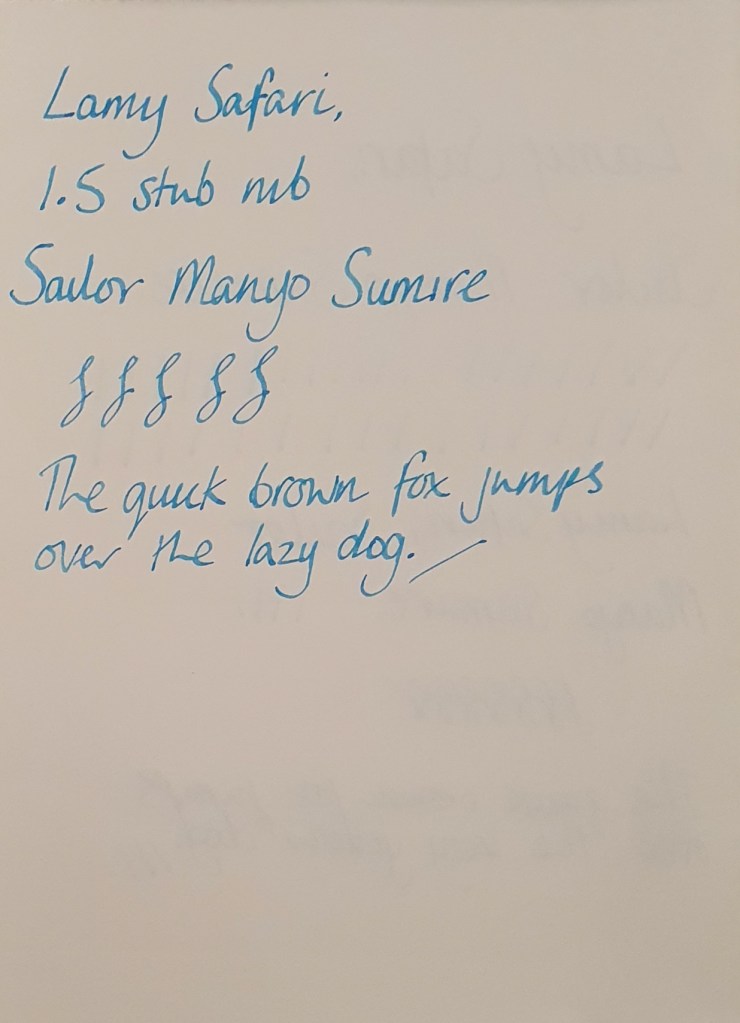
Adding new nibs to a Lamy Safari is a relatively cheap and really easy way to modify your pen and writing style. Again, this was one of the things that appealed to me when buying it. New nibs for the Safari range from €6 to €100+, depending on nib material used, however, stainless steel nibs typically cost €6 / £5 / $7 and this is great for someone starting out with fountain pens.
Like any topic, choice of fountain pens is a polarising one. For every post or review you read recommending the Lamy Safari online, you will probably see another disparaging it. I can honestly say that having now tried the vast majority of nibs Lamy has to offer – both gold and stainless steel – I am yet to encounter one that has written badly out of the box. That is not to say that talk of poor quality control is exaggerated or untrue, because any large manufacturer will invariably suffer from poor quality control issues from time to time.
If you are just starting out with fountain pens, the Lamy Safari is a fine choice. Its low price point and modularity will appeal to those looking to dip their toes into the murky waters of fountain pens; it is hard wearing so you won’t have to worry about it breaking; and it comes in such a wide range of colours that there is bound to be one to suit your personality and needs.
Pros:
- Inexpensive
- Looks
- Robust materials and design
- Ability to change nibs easily
- Takes a converter
- Available in many different colours
Cons:
- Still more expensive than a ballpoint
- Design polarising and more childlike than a traditional fountain pen
- Converter does not come as standard
- Ergonomic section is not for everyone
Final thoughts
At less than €20/£20/$20 and available in a host of colours and nib sizes, everyone should have at least one version of this iconic pen in their collection.
Still not convinced?
The Lamy Al-Star is essentially the same pen, just with an aluminium body instead of ABS. It usually costs about €5/£5/$5 more.
 Fountain Pen Writinerary
One thought on “Of Starter Pens, or How I Learned to Stop Worrying and Love the Lamy Safari”